What to Teach Your Toy Poodle During the First Week Home
In the first week home, teach your Toy Poodle the basic rules of daily life: where to toilet, where to rest, what their name predicts, how to come a short distance, how to cooperate with coat care and how to remain settled when you move away briefly. Those foundations matter more than sit, heel, stay or a collection of tricks.
Keep the standard realistic. By day seven, you are looking for early recognition and willing participation—not polished behavior. A good first week gives a Toy Poodle clear patterns to follow without overwhelming a very small dog in an unfamiliar home.
Prepare the home for a dog who is small and observant
Management should do most of the work at first. Use doors, gates or a pen to limit access rather than repeatedly calling your new dog away from furniture, cables and busy doorways. Because a Toy Poodle can disappear behind a chair or stand directly at your heels, everyone should pause before stepping backward, moving a recliner or closing a door.
Decide on the household rules before training begins. Agree on:
- One word for calling the dog, such as here.
- One brief marker, such as yes, to identify a rewarded choice.
- A permanent toilet location.
- A bed, mat or pen that will serve as the main resting place.
- Whether the dog may use sofas and beds.
- How family members will respond to jumping, barking for attention and following underfoot.
Consistency is especially useful with an attentive Toy Poodle. If one person rewards jumping while another asks for four paws on the floor, the dog is learning two competing rules.
The six lessons that deserve priority
1. The daily rhythm
Start by making the day predictable. Offer a toilet opportunity after waking, meals and energetic play, then guide your Toy Poodle toward a quieter activity or rest. Use the same route and the same toilet location whenever practical. Reward in that location as soon as the dog finishes.
A simple cycle—wake, toilet, activity, toilet, rest—reduces guesswork for both dog and owner. It also suits a Toy Poodle puppy, whose lively bursts can be followed quickly by a need to sleep. The guide to why Toy Poodles can seem difficult to potty train covers the management details in greater depth.
2. A name that earns attention
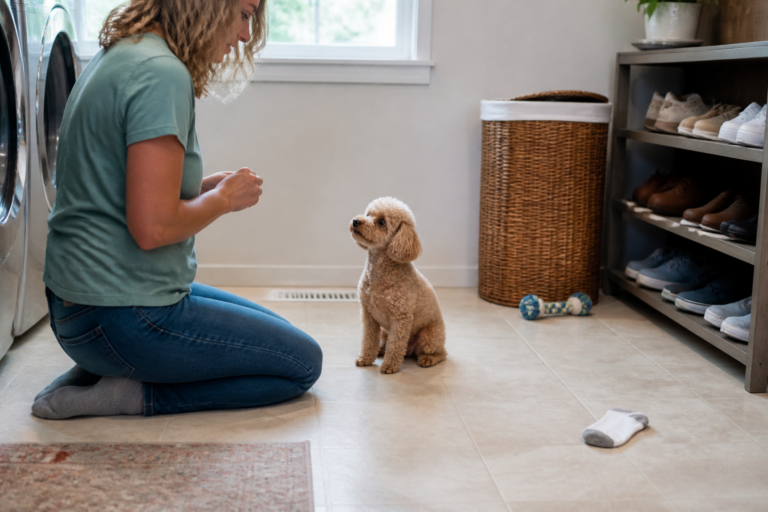
Wait until the room is quiet, say your Toy Poodle’s name once and reward any turn toward you. A full approach is not required. At this stage, the lesson is simply that hearing the name makes it worthwhile to check in.
Three good responses are enough for one session. If nothing happens, make the next attempt easier by moving closer or choosing a less interesting setting. Repeating the name several times teaches the dog that the first call can be ignored.
3. A rewarding indoor recall
Begin only a step or two away. Say the name, add your chosen recall word and move backward slightly. When your Toy Poodle reaches you, reward close to your feet so the complete behavior includes coming all the way in rather than stopping beyond arm’s reach.
Sometimes release the dog back to the activity afterward. If every recall ends play, the cue may begin to predict disappointment. During the first week, practise in enclosed rooms and hallways rather than testing the cue in distracting outdoor spaces.
4. A place to switch off
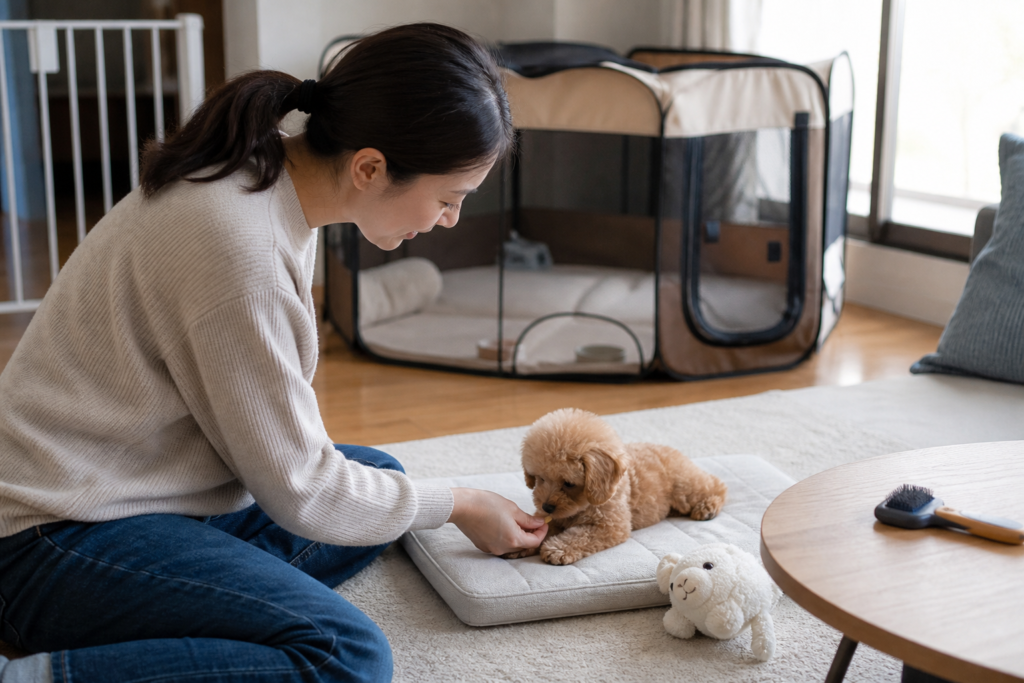
Choose a low bed or mat that is easy for short Toy Poodle legs to access. Place it where the dog can observe ordinary household life without being in the main walking route. Whenever your dog approaches it, steps onto it or lies down, quietly place a reward on the surface.
There is no need to add a formal stay. The useful first lesson is that the station offers comfort, calm attention and occasional rewards. If you are using a pen or crate, begin with the entrance open so the dog can explore and leave freely.
5. Cooperative grooming and safe lifting
A Toy Poodle’s coat makes grooming practice a first-week necessity rather than an optional extra. Do not attempt a long brushing session immediately. Start with one easy interaction: show the brush, reward interest, make a single light stroke across a comfortable part of the body and stop.
Over separate sessions, introduce brief contact around the chest, legs, paws, ears, tail and muzzle area. Allow the dog to shift position or walk away. Cooperation grows more reliably when your Toy Poodle learns that calm participation is rewarded and that each exercise has a clear ending.
Lifting also needs a predictable routine. Say a cue such as up, place one hand beneath the chest and the other beneath the rear, then lift while keeping the dog supported against your body. Lower slowly until all four paws meet the floor. Avoid scooping up a Toy Poodle without warning simply because the dog is small enough to carry.
6. A few calm seconds apart
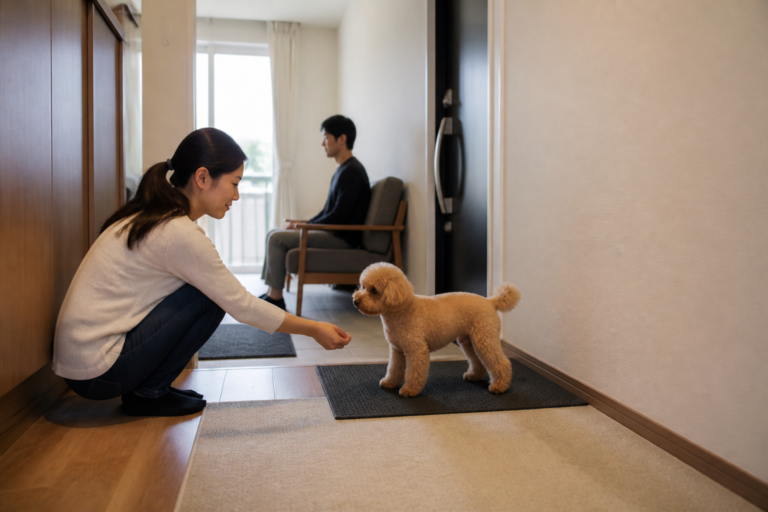
Practise separation while you are still in the house. Wait until your Toy Poodle is occupied on a bed or behind a gate, step away, then return before the dog feels the need to follow. Your first attempt might involve one step and less than a second out of reach.
Build from the version your dog can already manage. You might add a second of time, take one extra step or briefly pass from view, but do not change all three at once. Return in an ordinary manner so departures and reunions do not become the most exciting events of the day.
A first-week schedule that builds one layer at a time
Day 1: teach the map of the home
Show your Toy Poodle the toilet area, water location, sleeping station and permitted rooms. Keep the environment quiet enough for exploration. Reward naturally useful choices, including approaching the bed, checking in with you and selecting an available toy.
Day 2: establish your shared language
Introduce the marker by saying it and immediately delivering a tiny reward several times. Later, use it when your dog responds to their name or steps onto the resting mat. The marker should identify the exact choice that earned the reward.
Day 3: begin body-care skills
Pair the lifting cue with your hands moving gently into position. Not every repetition needs to include an actual lift. Add one brush stroke and one short touch near a paw, finishing while your Toy Poodle is still comfortable and engaged.
Day 4: make following you a game
Call your dog across a quiet room two or three times. Reward near your legs, then let the dog move away again. You can also reward voluntary check-ins as you walk between rooms, which helps a tiny dog learn to track your movement without weaving around your feet.
Day 5: introduce a barrier
Use a gate or pen for a very short separation while the dog has a calm activity. Stay nearby at first. If your Toy Poodle immediately leaves the activity to follow, reduce the distance and make the next attempt shorter.
Day 6: add equipment without rushing
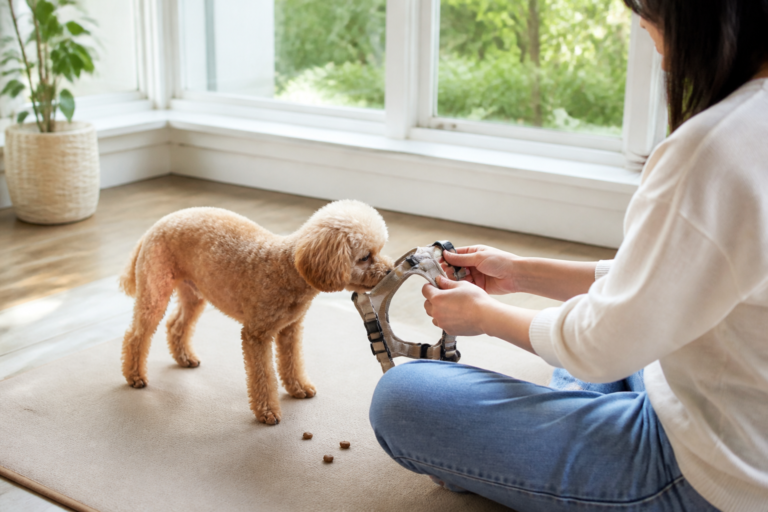
Let your Toy Poodle inspect a harness before asking the dog to wear it. Reward a nose moving toward the opening, brief contact with the straps and calm handling around the chest. The full process is explained in helping a Toy Poodle feel comfortable in a harness.
Day 7: notice what has become familiar
Use the final day to observe rather than test. Does your Toy Poodle turn after hearing their name? Follow the toilet route? Choose the mat? Come across the room? Accept one or two brush strokes? Remain occupied while you take a step away?
Keep practising whichever versions are working. There is no benefit in celebrating the end of the week with a difficult recall, a long confinement period or an extended grooming session.
Choose equipment that suits a Toy Poodle’s scale
Training tools should fit the dog and the task. A low, washable mat is easier to approach than a deep bed with high sides, while a pen should provide a usable resting area without becoming the center of constant household traffic.
Whatever equipment you choose, introduce it through brief, rewarded interactions. The product itself does not create calm behavior; the gradual routine around it does.
Keep rewards tiny and sessions informal
A Toy Poodle needs very little food for each successful repetition. Use pieces small enough to swallow quickly, and account for training rewards within the dog’s regular daily food. Several useful responses should not turn into a separate meal.
Most sessions can end within 30 seconds. Name response might take three repetitions. Recall could be two trips across the room. Grooming practice may be one brush stroke followed by a release. Short lessons preserve enthusiasm and fit naturally between toilet trips, play and rest.
Do not overlook behavior that occurs outside planned sessions. Quietly reward your Toy Poodle for lying down while you work, waiting instead of jumping, moving away from your feet or entering the pen voluntarily. Capturing these moments often shapes household manners faster than repeatedly asking for commands.
Change only one challenge at a time
Training becomes harder when you add distance, time or distraction. Alter one of those elements while keeping the others familiar. For example, call your Toy Poodle from farther away in the same quiet room, or practise the usual short distance with one mild distraction present.
If the dog wanders off, becomes absorbed in something else or stops participating, simplify the next repetition. That may mean moving closer, using a quieter room or ending after an easier success. First-week behavior reflects the new setting as much as the dog’s underlying ability.
What if the new Toy Poodle is an adult?
An adult Toy Poodle benefits from the same priorities, even if the dog already knows several cues. First establish your household’s toilet route, resting place, recall word and handling routine. Previous experience with grooming, pens or being carried does not guarantee that the dog will immediately understand how those activities work with a new person.
Observe before making assumptions. An adult may know a different recall word, prefer a particular resting surface or expect another signal before being lifted. Reward voluntary cooperation and introduce your rules in small, clear steps.
What successful first-week to teach your toy poodle looks like
At the end of the week, your Toy Poodle may look toward you when their name is spoken, travel a short distance on cue, anticipate the usual toilet route, settle briefly on a chosen mat and accept a small amount of brushing or handling. The dog may also remain relaxed for a moment when you move to the other side of a gate.
Those responses do not need to be reliable yet. The real achievement is a workable routine: your Toy Poodle is beginning to understand where everyday activities happen, how to earn rewards and what to expect from the people in the home.