How to Get a Toy Poodle Comfortable Wearing a Harness
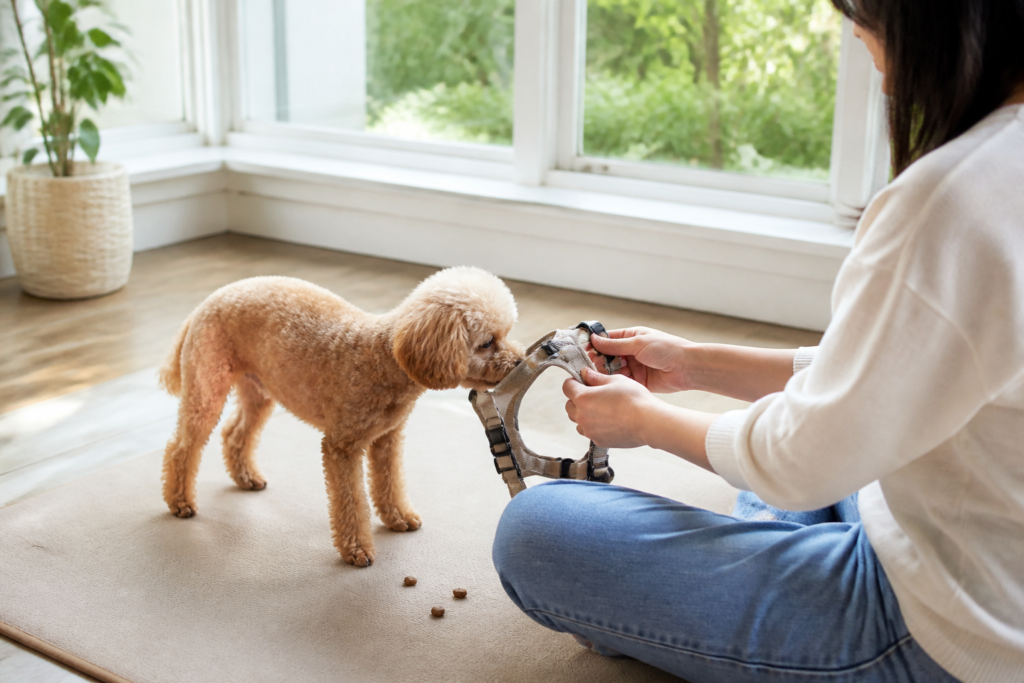
To get a Toy Poodle comfortable wearing a harness, teach the putting-on process before expecting the dog to wear it for a walk. Work on one action at a time—approaching the harness, putting in the head or paws, hearing the clip and moving while dressed. Keep the harness still, let your Poodle make the next move and reward each easy repetition.
Set up the harness before training
Begin with the harness adjusted approximately to size. Struggling with tight sliders while it is already on your dog can turn a simple lesson into a long handling session.
Toy Poodles have compact bodies, fine legs and a coat that can hide where a strap is sitting. With your dog standing on a non-slip surface, check that the harness:
- rests below the throat rather than pressing across it;
- leaves room for the shoulders and front legs to move;
- does not pull curls into the clips or adjustment sliders;
- remains upright instead of twisting toward one side; and
- stays in place when gentle backward pressure is applied.
Follow the fitting directions supplied with that particular design. Toy Poodle proportions vary, and a harness that fits through the chest may still have an overly generous neck opening. Check the stitching, leash attachment and fasteners at the same time.
Choose a calm place and a useful reward
Practise away from the front door, preferably when no walk is due. A Toy Poodle who associates the harness with an exciting dash outside may find it much harder to stand or think clearly during the lesson.
Sit on the floor or on a low seat so that you are not leaning over such a small dog. Use tiny pieces of food that can be swallowed quickly; several large treats can fill a Toy Poodle before the session has achieved much. A favourite toy may also work, provided it does not send the dog racing around the room.
A session can finish after three or four smooth repetitions. There is no advantage in continuing until your Poodle loses interest or begins grabbing the straps.
First teach calmness around the harness
Put the harness beside you on a mat. Stay quiet and reward your Toy Poodle for choosing to come near, sniff or stand beside it. If the dog remains at the other end of the room, move the harness farther from the training spot instead of carrying it after them.
Once its presence is unremarkable, pick it up without reaching toward the dog. Reward a settled response and lower it again. Repeat from different positions so the harness is not only acceptable when lying flat.
If your Poodle pounces on it, keep your hand still and wait. Continue when the dog releases the strap and pauses. Pulling it away quickly can create an entertaining chase or tug routine. A useful next read is Why Is My Toy Poodle Peeing Inside Again?.
Teach the entry action that matches the design
The most useful exercise depends on how the harness goes on. An over-the-head model asks the dog to move through a neck loop. A step-in model requires accurate front-paw placement. A harness with an opening neck can be introduced without passing a loop over the face.
Over-the-head harnesses
Hold the neck loop open at your Toy Poodle’s nose level. Keep your hands steady and reward any deliberate investigation of the opening. Gradually wait for a little more: the nose between the straps, the muzzle through the loop and eventually the whole head through.
Deliver the reward on the far side of the opening, but do not use food to draw the dog in and then drop the loop over the ears unexpectedly. Your Poodle should be able to withdraw during these early repetitions.
A familiar hand-touch cue can make the task clearer. Place your target hand beyond the loop and let the dog reach through to touch it. As confidence grows, allow the loop to settle briefly around the neck before lifting it off again.
Step-in harnesses
Lay the harness open on a rug so it will not slide. Reward your Toy Poodle for standing near it, then for placing a front paw inside either opening. Two small paper squares can be used first if the straps are distracting: teach the dog to put one paw on each square, then place the squares beneath the harness openings.
If you need to position a paw by hand, rehearse that separately. Touch the leg lightly, reward and stop. Build up to lifting the paw just high enough to clear a strap. Avoid holding a delicate front leg while the dog twists away.
Harnesses that open at the neck
These designs can suit a Toy Poodle who happily wears a harness but dislikes having a loop travel over the face and ears. Practise bringing the open straps around the shoulders and taking them away again before adding the fastening step.
Introduce touch and clips as separate lessons
Before assembling the whole harness on your dog, briefly place one strap against the chest or side. Reward, then lift it away. Change the contact point over several repetitions until straps touching the body no longer interrupt what your Poodle is doing.
Clips deserve their own practice because the sound can occur close to a Toy Poodle’s head. Close the buckle in your lap, reward and reset it. Over later sessions, hold it nearer to the harness position. Keep your fingers between the clip and the coat until you are sure no curls are caught.
When entry, strap contact and the fastening noise are each easy, join them together. Put the harness in position, close one buckle, offer a reward and take everything off. The first complete trial should be brief enough to feel almost uneventful.
Help your Toy Poodle move naturally while wearing it
Some dogs cooperate with dressing and then stand as if the harness has switched off their legs. Rather than pulling on a leash, encourage a small action they already enjoy. Toss a treat a short distance, ask for a hand touch or walk two steps across the room.
Because a Toy Poodle is close to the floor, even a lightweight dangling strap can tap a leg or catch a paw. Tuck loose ends into their keepers and make sure the leash is not attached during the first movement exercises.
Start with a few steps. If your Poodle walks freely, turns and settles while wearing the harness, extend the time gradually. Remove it before the dog starts trying to play with it. Harnesses should be put away between supervised practice sessions rather than left on around the home.
Transfer the skill to the walking routine
Attach the leash indoors once your Toy Poodle can move comfortably in the harness. Hold enough slack that the leash does not alter the fit, then practise following you around furniture, changing direction and stopping on a mat.
Next, rehearse near the exit without opening the door. Put on the harness, clip the leash, reward a moment of composure and return to the room. This prevents the doorway from becoming the place where every part of the routine happens at top speed.
For the first outdoor practice, choose a short, quiet trip. Check the harness again before leaving, particularly if your Poodle tends to reverse when surprised. A correctly fitted model should remain secure when the dog steps backward.
Adjust the plan when something goes wrong
The harness makes your Poodle leave the room
Stop using it as a signal that you are about to catch the dog. Leave it on the mat during a few relaxed training sessions and reward your Poodle for choosing to stay in the area. Do not attempt to put it on during those sessions.
Your Poodle stops at the neck loop
Return to nose-level work and keep the opening motionless. Check whether tags, clips or thick straps are brushing the face. If the entry method remains the only objection, an opening-neck design may make daily dressing simpler.
Paw placement turns into a balancing act
Use a rug and keep the harness flat. Toy Poodles have small feet, so narrow loops that fold inward can be difficult to aim for. Hold each opening wide or teach placement with larger floor targets before reducing the target size.
The dog bites at the straps
First check for a hanging adjustment end or curls caught under the harness. If the setup is tidy, give your Poodle something else to do immediately after fastening, such as walking to a mat for a reward. Take the harness off before strap chewing becomes the usual end to every repetition.
Excitement takes over before a walk
Separate harness practice from departure. Put it on at quiet points during the day, walk around one room and remove it. During the actual walking routine, wait for a brief pause in jumping or spinning before completing the next fastening step.
Allow for coat changes between grooms
A Toy Poodle’s harness fit can change noticeably as the coat grows or is clipped. A setting that was secure over a full coat may be loose after grooming, while longer curls can make the same straps sit too firmly.
Before fastening, use your fingers to flatten the coat beneath the chest and side straps. After the walk, check the armpits, chest and buckle areas for bunched or knotted curls. Removing ordinary walking gear indoors also reduces friction along the same coat lines.
Ear furnishings can be caught when an overhead loop is removed. Lift the loop forward and clear of the ears instead of dragging it back through the curls. For additional coat-care guidance, see How to Prevent Matting Behind a Toy Poodle’s Ears.
When to move to normal walks
Your Toy Poodle is ready for regular use when the harness can be put on without chasing or holding the dog in place. The dog should also be able to walk, turn, sit and follow you indoors without becoming preoccupied with the straps.
Do not judge progress by how long your Poodle remains still. A dog who willingly returns for the next repetition and moves normally once dressed is giving you much more useful information. Build from that cooperation, and the harness will become an ordinary part of the walking routine rather than a daily contest.