How Do I Teach a Toy Poodle to Leave Household Items Alone?
Teach a Toy Poodle to leave household items alone by combining secure storage with carefully staged practice. Reward the moment the dog turns away from an object, add a “leave it” cue only after that response is reliable, and use a calm swap for anything already in the mouth. The household setup matters as much as the cue because training cannot control belongings left within reach when no one is watching.
Toy Poodles are quick observers of human routines. They can learn that picking up a sock makes everyone rush over just as readily as they can learn that ignoring it earns a reward. Their small size also gives them a different view of the home: dropped tissues, trailing laundry and objects beneath low furniture sit directly in their working space. Effective training must account for both that physical access and the breed’s talent for spotting patterns.
First, work out what the item grabbing achieves
Do not assume every stolen object serves the same purpose. Soft laundry may be satisfying to carry, while a remote may be interesting mainly because taking it starts an exciting chase. Poodles also have a retrieving background, so some individuals simply enjoy holding and transporting objects.
For a few days, make brief notes whenever the behaviour occurs:
- Which objects are chosen most often?
- Are they carried, hidden, chewed or displayed?
- Does grabbing happen during busy transitions or when attention has stopped?
- What do people do next?
- Which toys or activities were available nearby?
Look for a repeatable sequence. A dog who raids an open hamper needs a different first step from one who collects a shoe whenever the household becomes quiet. In the first case, change the storage. In the second, offer an appropriate carrying or searching activity before that quiet period begins.
Arrange the home for a toy-sized dog
Spend a few minutes viewing each room from close to floor level. Shoes tucked under a bench, a tissue box on a low shelf and a child’s toy beside the sofa may appear stored to a person while remaining fully available to a Toy Poodle.
Use closed hampers, cabinets and lidded containers for frequently targeted belongings. Move remotes away from the edge of tables, keep bags zipped and place children’s possessions in a separate play area. Doors or gates can limit access to rooms that have not yet been prepared.
Keep powered, sharp, fragile or very small objects out of training setups altogether. Practice with clean, sturdy items that are easy for you to control and that hold no special value.
This is not avoiding the training problem. Each prevented raid removes another opportunity to rehearse grabbing and running. It also allows you to create planned lessons in which the correct choice is clear.
Give carrying behaviour an acceptable outlet
A legal alternative should resemble the feature the dog appears to like. For a laundry collector, that might be a light fabric dog toy that is easy for a small mouth to hold. A Toy Poodle interested in moving objects from place to place may enjoy carrying a soft toy to a bed or putting toys into a low basket. Dogs that search through bins can be directed toward a simple food-search game instead.
Put the alternative where the unwanted behaviour usually begins. A toy stored down the hall is unlikely to compete with a sock beside the chair. Occasionally reward the dog for selecting the permitted item without being prompted. That makes good choices valuable before any theft occurs. A useful next read is How to Get a Toy Poodle Comfortable Wearing a Harness.
Teach the turn-away before adding words
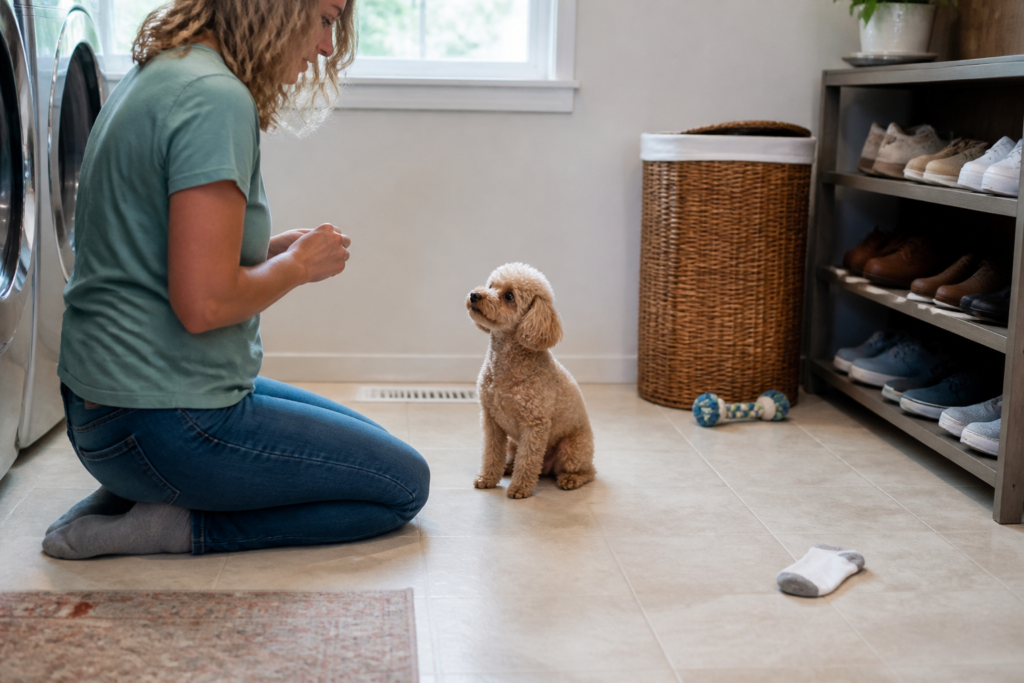
The essential skill is not merely resisting an object. It is noticing the object and redirecting attention. Begin in a quiet room with one boring, sturdy household item placed several feet away. Keep yourself between the dog and the item if necessary, but leave enough distance for relaxed observation.
- Allow the dog to notice the staged object.
- Wait without repeating their name or waving food.
- As soon as they look away, step back, or glance toward you, mark the choice with “yes” or a click.
- Give the reward beside you or slightly behind the dog, away from the object.
- Move the item or change your starting position before the next repetition.
Keep the first sessions to four or five successful choices. Toy Poodles often learn quickly, but rapid learning can include unwanted details. If every repetition begins with you bending toward the object, for example, the dog may wait for that movement instead of responding to the object itself. Vary your posture and approach.
Add “leave it” when the response is easy
Once the dog regularly turns away, say “leave it” just before they are likely to make that choice. Use the words once, then mark and reward the response. The cue should predict disengagement, not begin a stream of repeated instructions.
If the dog pulls toward the object or remains absorbed by it, increase the distance or choose something less interesting. Making the task easier protects the meaning of the cue. Physically blocking repeated attempts while saying “leave it” over and over usually creates frustration rather than understanding.
Build difficulty in small, deliberate steps
Toy Poodles can appear to master a lesson after only a handful of repetitions. That speed is useful, but it can tempt people to progress from a plain object in a quiet room straight to an appealing sock during a busy morning. Instead, change one detail at a time.
- Begin with a dull object at a generous distance.
- Move a little closer while rewarding voluntary check-ins.
- Walk past the object rather than standing still.
- Use a more realistic item, such as a clean shoe or folded towel.
- Practise while someone makes a small household movement nearby.
- Set up an easy version of the lesson in another prepared room.
- Add mild movement, such as carrying a laundry basket past the training area.
A change of room, object or motion can make the exercise feel completely new to the dog. If performance becomes hurried or unreliable, return to the previous easy version. Progress comes from a high rate of correct choices, not from seeing how much temptation the dog can withstand.
Reward choices made without a cue
The strongest household habit is an automatic one. During supervised time, quietly notice when the dog passes a shoe, backs away from dropped laundry or looks at you after spotting something on the floor. Mark and reward those moments even though you did not ask for them.
Deliver the reward away from the belonging. This gives the dog a practical next move: turn from the object and come toward you. Over time, the appearance of an unattended item can become a reason to check in rather than investigate.
Rewards do not always need to be elaborate. Food is convenient for precise practice, but access to a favorite toy, a short game or permission to begin a sniffing activity can also reinforce the choice. Use what the individual dog values in that setting. A useful next read is Why Is My Toy Poodle Peeing Inside Again?.
Use a separate cue for releasing an item
“Leave it” applies before an object is taken. Once something is in the mouth, use a distinct word such as “drop” or “swap.” Teaching the two actions separately avoids asking one cue to mean opposite things.
Practise release with dog-owned toys rather than waiting for a household mistake:
- Offer a low-interest toy and allow the dog to take it.
- Present a reward near the nose without pulling on the toy.
- Mark the instant the mouth opens.
- Give the reward, then pick up the toy.
- On some repetitions, offer the toy again.
Returning the permitted toy sometimes teaches that releasing an object does not always end the activity. Keep these lessons calm. Many Toy Poodles respond closely to changes in voice and body position, so looming overhead or becoming stern can distract from the action you are trying to teach.
What to do when your Toy Poodle takes the wrong thing
Avoid chasing, cornering or turning the incident into tug. Those reactions can make possession of the object more exciting and may teach the dog to retreat under furniture, where a small Toy Poodle can be difficult to reach.
Instead, stop advancing and offer a worthwhile swap. When the dog releases the object and moves toward the reward, collect the item without ceremony and put it away. Then offer an approved toy or another simple activity.
A valuable swap during an unplanned mistake does not have to create deliberate stealing. Problems arise when the dog repeatedly gains access to forbidden objects and every theft starts a long, rewarding interaction. Keep accidental swaps brief, improve storage afterward and provide far more reinforcement for ignoring belongings or choosing legal toys.
A simple daily practice plan
Short sessions suit a bright, people-focused dog better than a long drill. A useful daily pattern is:
- Morning: three or four turn-away repetitions with an easy staged object.
- Later in the day: a one-minute “drop” game using a dog toy.
- During normal routines: reward one or two spontaneous check-ins near safely arranged belongings.
- Before a busy transition: put tempting items away and provide an approved carrying, chewing or searching activity.
Stop while the dog is still engaged and successful. Because Toy Poodles readily notice inconsistencies, everyone in the home should use the same cues and follow the same rule: household belongings are unavailable, while dog toys can lead to play and attention.
Adjust the plan when progress stalls
The dog responds only after seeing food
Keep rewards in a pocket or on a nearby shelf. Mark the correct choice first, then reach for the reward. This preserves reinforcement without making visible food part of the cue.
The cue works beside one staged item but nowhere else
Return to easy objects and introduce them in several prepared locations. Reduce the challenge whenever you change rooms. Do not increase distance, movement and object appeal all at once.
The dog grabs things and waits to be pursued
Remove the chase from the sequence. Use the brief swap routine, put the item away and reserve animated attention for approved toys. Also check whether the dog needs more planned interaction before the usual grabbing time.
The dog chooses laundry over every toy
Experiment with legal items that offer a similar carrying experience while remaining clearly distinguishable from clothing. Store real laundry consistently, place the approved toy near the former access point and reward the dog for picking it up.
Mistakes occur only when no one is present
That is an access problem rather than a failed cue. Limit the dog to a prepared space and secure the targeted belongings. Gradually expand access only after the new habits are well established during supervised periods.
Know when a setup is too difficult
Pause the exercise if the dog plants themselves over the object, tries repeatedly to escape with it, becomes unusually still or stops responding to familiar rewards. Do not test the same situation again immediately. Increase distance, lower the object’s value and rebuild the lesson with easier choices. If possession-related behaviour makes home practice difficult, seek individual help from a reward-based trainer or behaviour professional.
What successful training looks like
Progress is not measured by scattering tempting belongings around the home. It shows when the Toy Poodle can pass several controlled objects, respond to one cue, release dog toys willingly and increasingly turn toward a person without being asked. Continue storing valuable and unsuitable items securely. The finished skill is a combination of a thoughtfully arranged home and a dog who has learned that leaving human belongings alone is consistently worthwhile.