How Much Sniffing Does a Toy Poodle Need on a Walk?
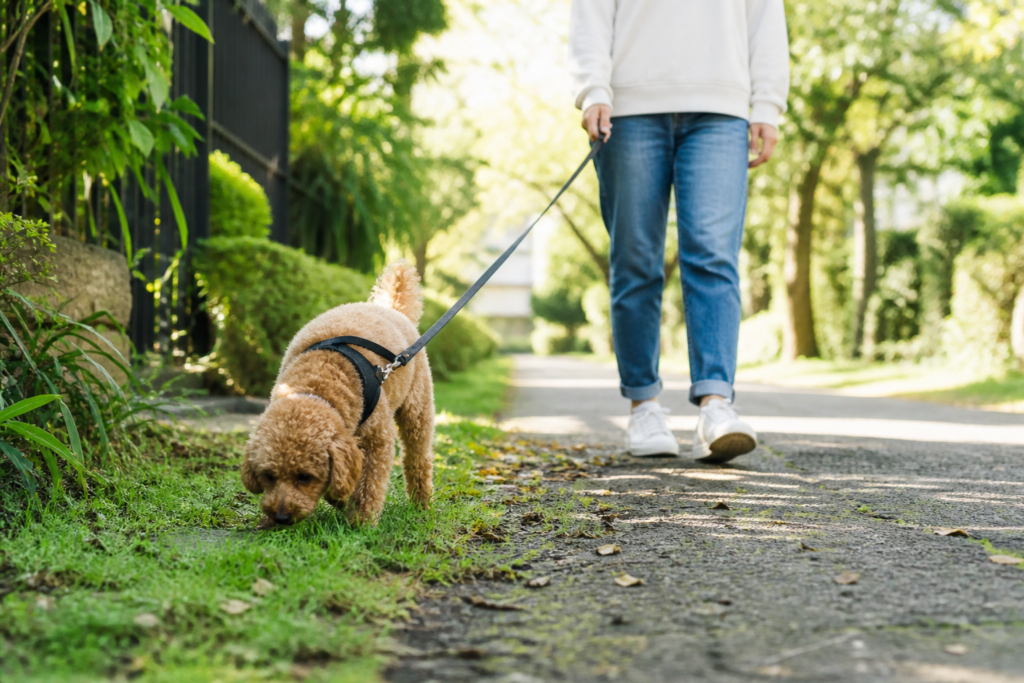
How much sniffing does a Toy Poodle need on a walk? There is no set time that suits every dog. A practical approach is to make room for several relaxed sniffing stops on an ordinary walk and occasionally let exploration set the pace for most of the outing. You can then adjust that balance according to your route, schedule, and dog’s interest.
Think in opportunities, not minutes
Sniffing is how a dog gathers information about a place. A familiar tree or grass verge may be worth checking again because the scents have changed since the previous walk. That does not mean you must wait beside every lamppost indefinitely, but a walk made entirely of hurried forward movement leaves little room to explore.
Instead of using a stopwatch, notice whether your route includes genuine opportunities to investigate. On a 20-minute neighborhood walk, that might mean a longer pause on a grassy stretch plus several brief stops elsewhere. On a quiet weekend outing, you might cover less distance and allow your dog to choose where to linger.
Build sniffing into the route
The easiest routine divides the walk into two modes:
- Moving together: Use a comfortable, steady pace where space is limited or you need to reach the next suitable area.
- Exploring: Pause somewhere safe, give the leash enough slack for easy movement, and let your dog examine the immediate area.
You do not need to plan these as separate walks. For example, you could walk briskly along a narrow pavement, stop for an unhurried investigation of a green space, then resume your normal pace for the journey home. This gives the outing some structure without turning it into a constant series of commands.
How long should a sniff break last?
Let the situation guide you. If your dog checks one spot and loses interest after a few seconds, continue walking. If there is plenty to explore and you have time, stay longer. The aim is to allow some choice rather than meeting a precise target.
Distance is not a useful score for a sniff-focused walk. A small dog may spend several minutes investigating one corner and cover very little ground. That is fine when exploration is the purpose of that section. Other outings can place more emphasis on continuous movement.
Use simple cues to prevent confusion
Two consistent phrases can make the change between walking and exploring easier to understand. Choose any words you like, provided everyone who walks the dog uses them in the same way.
Starting a sniff break
Stop beside an appropriate area, say “go sniff” once, and soften the leash. Give your dog time to look around without repeated prompting. The chance to explore is the reward, so there is no need to keep pointing at different patches of ground.
Moving on again
When it is time to leave, say “let’s go” and take a couple of inviting steps forward. Reward your dog for turning away from the scent and joining you. If leaving is difficult, move closer before giving the cue or practise beside a less interesting patch first.
Try not to repeat the phrase while standing still or pull your dog away as the usual way of ending every break. A clear cue followed by movement is easier to follow.
Keep exploration within sensible boundaries
Sniffing does not have to be available at every stop. Keep moving when you are crossing a road, passing a driveway, navigating a crowded path, or walking beside items your dog should not investigate. Do not allow a scent trail to lead onto private property or directly toward unfamiliar people and dogs.
A loose leash also matters. Your dog can choose among nearby scents without dragging you from one to the next. If the leash becomes tight, pause and wait for slack or guide the dog in another direction. This separates permission to explore from permission to pull.
Adjust the walk to the surroundings
Quiet routes usually make sniff breaks easier. On a busy street, you may need to keep them short and save longer exploration for a wider verge or open green space. Familiar routes are still useful; although the scenery looks unchanged to you, the scent landscape will not be identical each day.
For occasional variety, walk the usual loop in reverse, visit a neighboring block, or stop at a different patch of grass. Small changes are often enough. There is no need to find a new destination for every outing.
Frequently asked questions
Should every walk include sniffing?
Whenever practical, yes. Even a time-limited walk can include a few appropriate stops. The amount can vary: one outing may focus on getting somewhere, while another gives your dog much more freedom See lightweight long-line options on Amazon (paid link) to explore.
Should I let my Toy Poodle sniff whenever they stop?
No. Allow it where the surroundings are suitable, but use your walking cue when you need to maintain momentum or avoid an inappropriate area. Predictable opportunities elsewhere make those limits clearer.
Can a short sniff walk still be worthwhile?
Yes. A slow circuit of a small green space can be an engaging outing even when it covers little distance. It does not have to replace every longer or more active walk.
What if my dog does not sniff much?
Do not try to force it. Pause in a quiet area and offer enough leash slack to investigate, but continue if your dog would rather walk. Individual preferences vary, and interest may also change with the location.
A workable rule for everyday walks
Give your Toy Poodle regular chances to sniff, choose safe places for longer pauses, and make the transition back to walking clear. Some days that will mean a handful of short stops; on others, exploration can shape the entire route. A flexible routine is more useful than counting minutes.
More Living With a Toy Poodle guides
Browse more Living With a Toy Poodle guides or return to Start Here.