Why Does My Toy Poodle Follow Me From Room to Room?
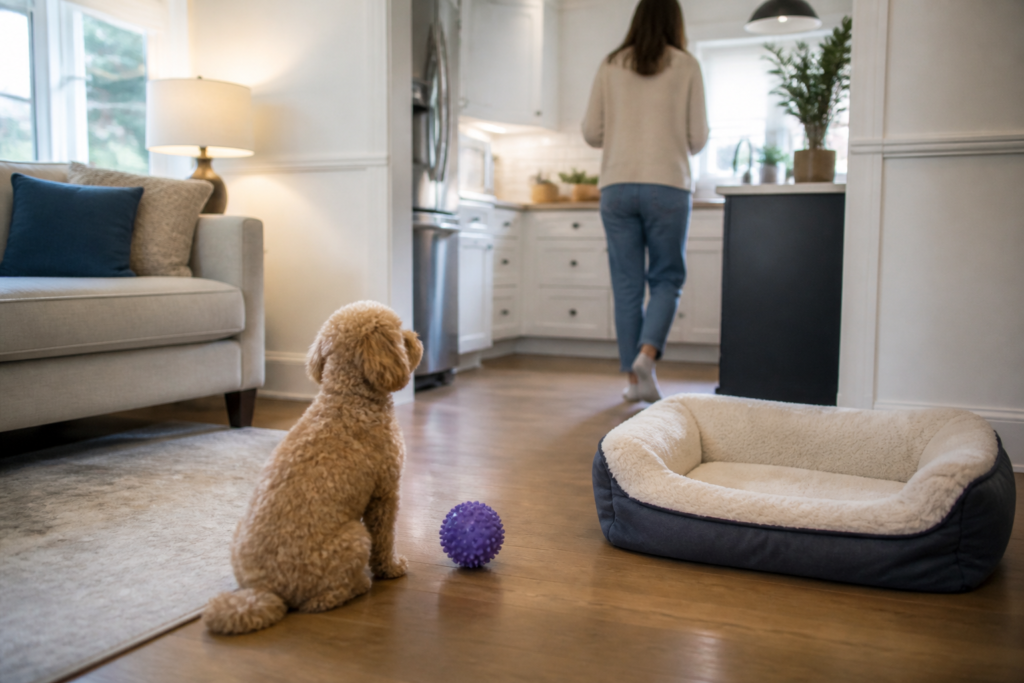
If you are asking, “Why does my Toy Poodle follow me from room to room?”, the most likely answer is simple: staying near you is enjoyable and often leads to something interesting. Your movements may predict food, play, an open door or a little attention. In most homes, this is an ordinary habit rather than a problem.
What matters is flexibility. A dog who trails you into the kitchen but can also remain on a bed when nothing is happening is behaving differently from one who cannot tolerate even a brief barrier between you.
What your dog may be expecting
Following rarely happens without a reason, even when that reason is not obvious. Watch the moments just before your dog gets up. You may discover that one of these everyday patterns is doing the work.
Your movement predicts an activity
Dogs become skilled observers of household routines. Reaching for a particular jacket might mean a walk. Opening a cupboard could mean dinner. Heading towards the sofa may signal that there is room for a cuddle.
Your dog does not need to know what will happen every time. The possibility of an enjoyable event can be enough to make following worthwhile.
Staying close brings attention
A glance, a few words or a quick stroke can reinforce shadowing. None of this is wrong, and you do not need to become distant with your dog. It simply explains why the habit can grow without anyone deliberately teaching it.
You are the most interesting option
If the room offers little to investigate, a moving person naturally becomes the main attraction. This is especially noticeable during quiet parts of the day, when there is no sniffing game, toy or comfortable resting spot competing for attention.
The routine is unfamiliar
Following may become more frequent after a move, a change in work hours or the arrival of a new household member. A recently adopted dog may also keep you in sight while learning where things happen. A predictable daily rhythm can make the home easier to understand.
They simply prefer company
Many companion dogs like to occupy the same room as their people. Some curl up nearby; others inspect every trip to the sink. A relaxed preference for company does not need to be corrected.
Look at the pattern, not just the following
Before changing anything, spend a few days observing when the behaviour occurs. You do not need a detailed diary. A short note on your phone can reveal whether “everywhere” actually means “before meals” or “whenever I walk towards the front door.”
Pay attention to four clues:
- Timing: Does your dog become watchful near a walk, meal or play session?
- Payoff: What do they receive after joining you—attention, access to another room or an activity?
- Body language: Do they wander casually and lie down, or remain fixed on your every movement?
- Choice: Can they sometimes stay behind when they already have a comfortable place or engaging task?
A calm follower may pause to sniff, return to bed or decide that your third trip to the laundry basket is not worth attending. The behaviour deserves more attention when your dog repeatedly abandons rest and activities to maintain constant access to you.
A simple test at home
Choose a quiet moment when your dog has no reason to expect food or a walk. Settle them on a familiar bed, take one or two steps away, then return. On another repetition, cross the room or step through an open doorway for a second.
The aim is not to find your dog’s limit. You are checking whether a very small amount of distance feels routine. If they stay put, that is useful information. If they rise immediately, you have found a skill that can be practised in easier stages.
A securely positioned camera can also show what happens when you briefly leave the room. Keep the observation short and ordinary rather than turning it into a long test.
Teach an alternative to shadowing
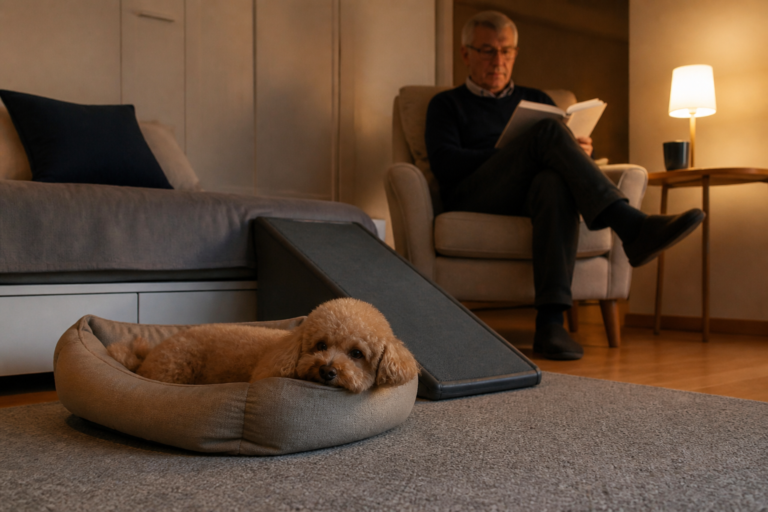
The clearest alternative is a designated bed or mat. Place it where your dog can still see household life without lying in a walkway. At first, the spot should feel included rather than isolated.
- Make the bed worth visiting. Drop a small reward onto it and allow your dog to step off again. Repeat until they approach readily.
- Notice voluntary pauses. When they sit or lie down there, place the reward between their paws. Quiet delivery helps keep the moment low-key.
- Add a cue. Once the movement is familiar, say “bed” or “place” just before they step onto it.
- Introduce tiny movements. Shift your weight, take half a step or reach towards a nearby object. Return and reward before your dog decides to follow.
- Use it during real routines. Practise while folding laundry, making a drink or answering the door rather than limiting the skill to formal sessions.
If your dog gets up, simply reset with an easier version. There is no need to repeat the cue, block their path or show frustration. One successful step is more useful than asking for a full minute before the behaviour is ready.
Give them a reason to stay
A bed becomes much more appealing when it offers something other than waiting. Depending on your dog’s preferences, try:
- a small food puzzle See small food-puzzle options on Amazon (paid link) that is easy to hold in place;
- a sniffing activity with part of their usual food;
- a familiar chew appropriate for their size and chewing style;
- a favorite toy reserved for quiet periods;
- a brief training game followed by time to rest.
Introduce new items while you are nearby and supervise their use. Small dogs can move or dismantle objects that appear sturdy, so choose products designed for their size and remove anything that breaks into loose pieces.
A well-chosen enrichment item can support this routine by making the resting area rewarding in its own right:
Variety helps, but constant entertainment is not the goal. Your dog should also have opportunities to do nothing in a comfortable place while ordinary household activity continues around them.
Change the cues that trigger automatic following
Some dogs leap up because familiar sequences are too reliable. Keys always mean leaving. A cupboard always means food. Shoes always mean a walk.
Occasionally perform one part of the sequence without completing it. Pick up your keys and put them down. Open the cupboard, take out a mug and carry on with your day. Put on your walking shoes well before the walk.
This does not require endless staged exercises. A few natural variations can stop every small movement from becoming an announcement. When the real activity begins, invite your dog to join you rather than allowing restless shadowing to be the only route to it.
Share the good parts of the day
If one person handles every meal, game and outing, that person will understandably attract the most attention. Other household members can take turns with feeding, short training sessions, play and walks.
This is not about weakening your bond. It broadens your dog’s routine and makes enjoyable activities less dependent on tracking one individual around the home.
When barriers change the picture
A dog may rest comfortably across the room yet get up as soon as a door starts to close. Treat doors and gates as separate training challenges rather than assuming distance practice will automatically cover them.
Begin with the doorway fully open. Walk through and return. Later, move the door a few centimetres, open it again and carry on. A secure gate can provide an intermediate step because your dog can still see the adjoining space.
Keep barriers stable and correctly fitted for a very small dog. Do not leave gaps where a paw, collar or head could become caught.
What tends to make the habit worse
Scolding a dog for following does not show them where to go instead. Repeatedly shutting them out without preparation can also make every doorway feel important.
Avoid turning independence practice into a waiting contest. If your dog repeatedly leaves the bed, scratches at a barrier or calls for you, the current step is not working. Go back to an open doorway, a shorter movement or a more appealing resting setup.
Rigidly ignoring your dog is unnecessary too. Continue to offer affection and companionship; just make a point of noticing the behaviour you want as well. Quietly resting several feet away should sometimes be more rewarding than standing under your feet.
Remember the practical safety issue
Toy Poodles are small enough to disappear behind a chair or stand directly beneath you without being noticed. Check the floor before stepping backwards, carrying a hot drink, opening an outside door or moving a heavy object.
A reliable place cue is particularly useful while cooking, bringing in shopping or greeting visitors. It gives your dog a clear job and keeps them out of busy routes without repeated corrections.
Frequently asked questions
Should I stop my Toy Poodle from following me?
No. There is no reason to eliminate friendly companionship. Work on an alternative only when the habit prevents rest, creates an underfoot hazard or makes routine movement difficult.
Should I refuse attention whenever my dog follows?
Not as a blanket rule. Respond naturally, but avoid making every trip across the room produce a reward. Give extra attention when your dog chooses their bed, stays engaged with an activity or waits calmly for an invitation.
How long does it take to teach independent settling?
There is no fixed timetable. Progress depends on the existing habit, the setting and how small you make the early steps. Short, successful practice during normal routines is usually more useful than one long session.
Why does my dog follow only one person?
That person may control the most valued activities or have the most predictable routine. Sharing meals, games, walks and training among household members can make the pattern less one-sided.
Affection and independence can coexist
Your small shadow is probably following because your company is rewarding and your movements provide useful clues about what happens next. If they can also rest, play or remain on a bed while you move around, there may be nothing to change.
When you do want more space, offer a clear alternative rather than discouraging closeness. A comfortable station, worthwhile activity and a few well-timed rewards can teach your Toy Poodle that joining you is optional—and staying behind can be pleasant too.
Browse more Living With a Toy Poodle guides or return to Start Here.