Why Is My Toy Poodle Peeing Inside Again?
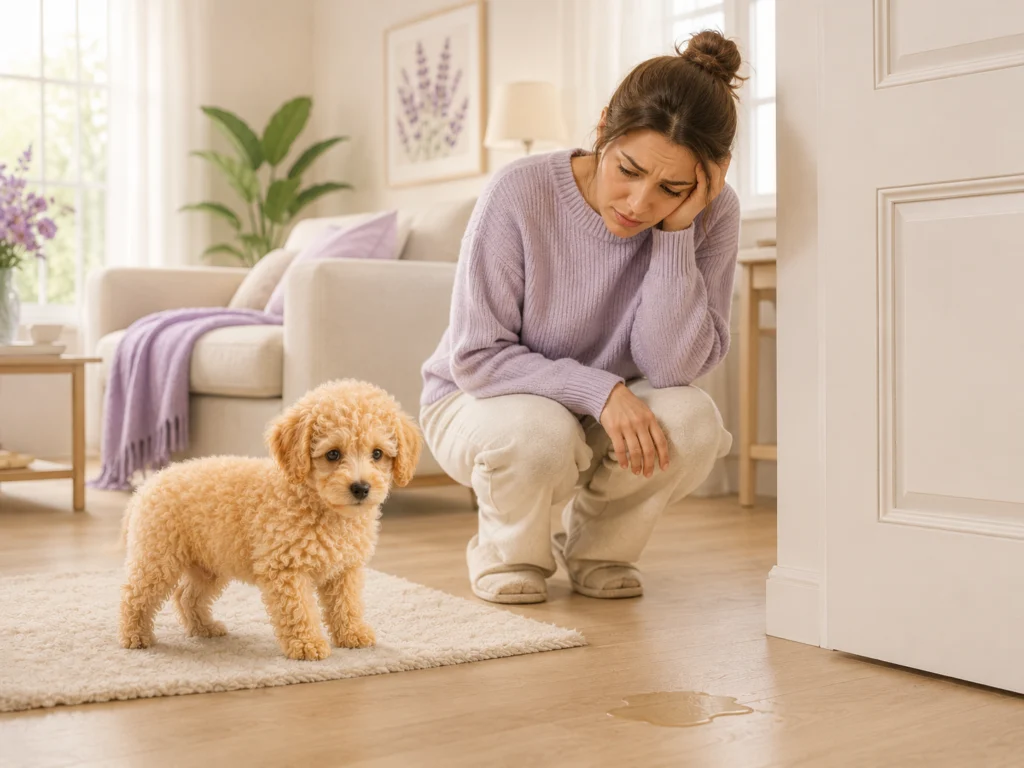
If your Toy Poodle is peeing inside again after making good progress, something in the routine has usually changed. It might be as simple as longer gaps between toilet trips, more freedom around the house, excitement, poor weather or missed signals. But if a previously reliable Toy Poodle suddenly begins having repeated accidents, it is also sensible to rule out a urinary or other health problem before assuming the training has failed.
The important thing is not to treat one puddle as proof that you are back at square one.
Instead, look at when the accidents happen, what your Toy Poodle was doing beforehand, and what has changed recently.
That usually gives you a much clearer answer.
Start with the pattern, not the puddle
When you find a wet patch on the floor, the natural reaction is to focus on the location.
The more useful question is what happened during the previous half hour.
Perhaps your Toy Poodle had just woken from a long sleep.
Maybe dinner had been followed by play instead of a toilet trip.
Perhaps your dog went outside but spent the whole time watching a neighbour and came back in without actually peeing.
Sometimes the answer is surprisingly ordinary.
For the next few days, notice the timing. You do not need a complicated chart. A quick note on your phone is enough.
You are looking for patterns such as accidents after meals, after naps, during evening play, while guests are visiting or during the longest gap between outdoor trips.
Once you see the pattern, you can fix the weak part of the routine instead of restarting toilet training from the beginning.
Has your Toy Poodle earned more freedom a little too quickly?
This is common with small dogs.
A puppy has a good week.
The gate comes down.
The bedroom door stays open.
Supervision becomes less intense.
Then an accident happens somewhere quiet.
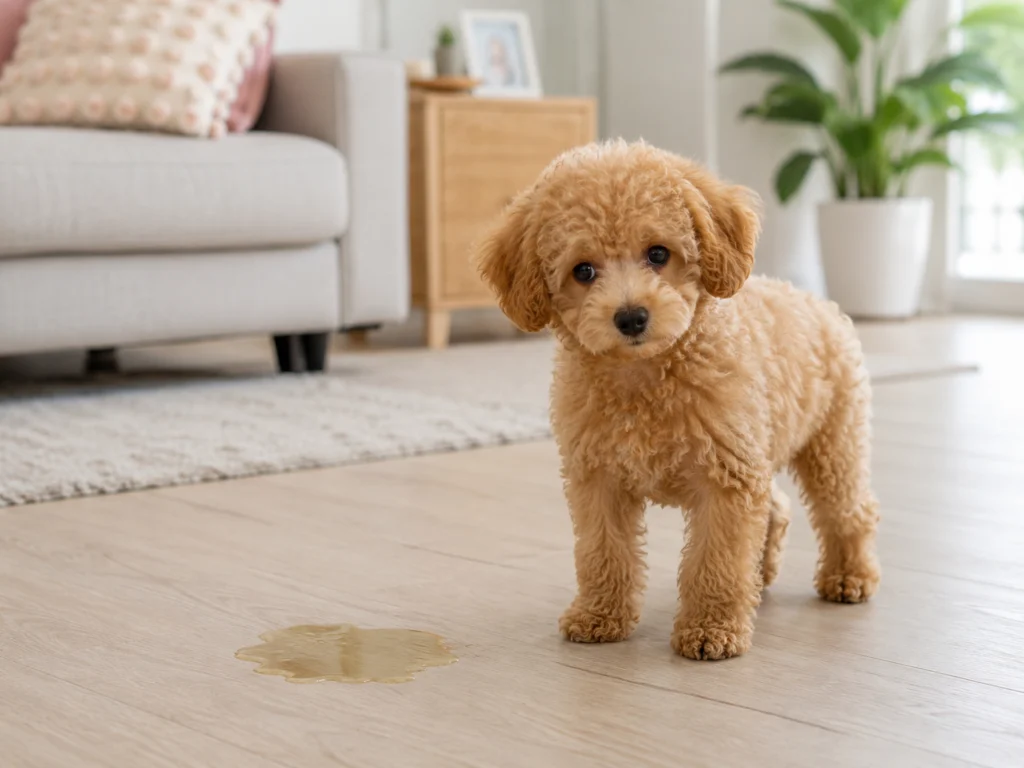
The problem is often not that your Toy Poodle has forgotten where to pee. They simply had access to more space before the toilet habit was completely dependable.
Toy Poodles can disappear behind a chair, under a table or into another room surprisingly quickly. By the time you realise they have wandered off, the decision has already been made.
For a few days, shrink the available space again.
Keep your Toy Poodle in the same room as you when possible. Close doors to areas where accidents happen repeatedly. Use a gate if there is one part of the house that is difficult to supervise.
This is not a punishment.
You are simply making it easier for your dog to make the right choice consistently.
If you are also rebuilding basic puppy habits, the Toy Poodle Training hub is the best place to continue.
Check whether the toilet trip actually happened
Opening the back door is not the same as confirming your Toy Poodle has emptied their bladder.
Small dogs can become distracted very easily.
They step outside, sniff one corner, hear a bird, stare at the fence and come straight back inside.
Five minutes later, there is a puddle beside the sofa.
For the important trips—especially first thing in the morning, after waking, after meals and after energetic play—stay with your dog long enough to know the job has been done.
Once your Toy Poodle pees, give calm praise or a tiny reward.
Then let them sniff for another moment.
That extra sniffing time can become part of the reward for finishing first.
A change in weather can change toilet habits
Some Toy Poodles have very strong opinions about rain.
Or cold grass.
Or wind.
Or anything that feels remotely inconvenient.
A dog who normally wanders around happily outside may suddenly rush back to the door after thirty seconds.
If indoor accidents appear during a spell of bad weather, look at whether the outdoor trips have quietly become shorter.
You may need to walk out with your Toy Poodle instead of simply opening the door.
Use the familiar toilet area and give them a minute to settle.
You do not need to turn every rainy toilet break into a long walk. You just want to avoid the pattern of:
outside briefly → nothing happens → straight back inside → pee on the rug.
Evening accidents often have a simple explanation
The late afternoon and evening can be messy.
Dinner happens.
People come home.
The dog gets excited.
There may be play, visitors, television, food preparation and several changes of room.
A Toy Poodle can go from calm to completely distracted in a few minutes.
This is when owners often miss the obvious toilet trip.
Try inserting one deliberate outdoor break into the busiest part of the evening.
Not because your dog must pee at exactly that time forever, but because it interrupts the part of the day where attention becomes scattered.
A predictable routine is especially useful for a small dog whose signals are easy to miss.
Learn your Toy Poodle’s quieter toilet signals
Not every dog stands dramatically at the door.
Some Toy Poodles give very subtle signals.
They may pause suddenly.
Leave the room.
Sniff along the skirting board.
Circle once.
Walk toward a hallway.
Stand near you and then walk away.
These behaviours are easy to overlook when you are working, cooking or looking at your phone.
If accidents are occurring while you are home, pay close attention to what your Toy Poodle does in the minute before disappearing from view.
You may discover that your dog has been asking for help all along—just not in the way you expected.
Clean repeat accident areas thoroughly
If one particular part of the room keeps attracting accidents, ordinary surface cleaning may not be enough.
Your nose may tell you the floor is clean.
Your Toy Poodle may disagree.
Use a cleaner designed for pet urine and follow the instructions on the bottle carefully.
Once the area is cleaned, temporarily block access if practical.
A chair, gate or closed door can prevent your Toy Poodle from repeatedly returning to the same spot while the new habit becomes stronger.
Rugs and bath mats can become too convenient
Soft absorbent surfaces can be tempting when toilet training slips.
A bath mat, small rug or pile of laundry may feel more appealing than a hard floor.
If accidents repeatedly happen on the same movable item, remove it for a while.
You are not solving the whole problem by taking away a rug.
You are removing an easy target while you work on timing and supervision.
If you use puppy pads as part of your actual toilet setup, keep their location consistent rather than scattering them through the house.
For a household aiming for outdoor toileting, I would use pads as a practical backup rather than allowing them to become a second toilet system everywhere in the home.
Do not turn accidents into a confrontation
Finding urine on the floor is frustrating.
But bringing your Toy Poodle back to the spot, raising your voice or making a big performance out of the puddle does not explain what should happen next time.
If you discover an old accident, clean it.
That is all.
If you actually see your dog beginning to pee indoors, calmly move them outside if it can be done without frightening them.
If they finish outside, reward that.
The useful lesson comes from making the correct behaviour easier to repeat, not from making the mistake dramatic.
Was the accident really a full toilet break?
There is a difference between a normal-sized puddle and a tiny amount of urine placed in a particular location.
A Toy Poodle who empties their bladder on the floor after a long gap may simply have needed a toilet trip sooner.
A dog leaving small amounts on vertical objects, new bags, furniture or particular household areas may be doing something different.
Likewise, a dog who suddenly squats repeatedly but produces very little urine may need veterinary attention rather than more training.
That is why the pattern matters.
Do not assume that every indoor pee has the same cause.
Sudden changes deserve extra attention
If your Toy Poodle had been reliably clean indoors for a long time and suddenly begins having repeated accidents, pause before changing the entire training plan.
Watch for other changes.
Examples include needing to pee much more frequently, increased thirst, discomfort, straining, licking around the urinary area, unusual urine colour, leaking during sleep or seeming generally unwell.
Those are situations where I would speak to a veterinarian rather than trying to solve everything with a tighter toilet schedule.
A training regression usually makes sense when you look at the routine.
A sudden physical change may not.
What if the accidents happen only when you leave?
That is useful information.
First check the obvious question: how long was your Toy Poodle expected to wait?
If the time alone is reasonable for that individual dog, look at what happens after you leave.
A simple indoor camera can tell you far more than guessing.
Does your Toy Poodle settle and then have an accident much later?
Do they begin pacing or vocalising soon after departure?
Did they even pee before you left?
Are accidents occurring only after particularly long absences?
Those are different situations.
If alone-time itself seems to be part of the problem, continue through Living With a Toy Poodle rather than treating every accident as a basic potty-training failure.
Try a three-day reset
You do not need an elaborate thirty-day programme.
For many routine-related regressions, three very deliberate days can tell you a lot.
Day one: supervise closely and take your Toy Poodle outside after waking, meals, significant drinking, energetic play and long rest periods.
Day two: compare the timing. Look for one point in the day where accidents are most likely and shorten that gap.
Day three: repeat the successful schedule instead of extending it immediately.
If your Toy Poodle stays clean, keep the routine steady for a little longer.
Do not rush back to maximum freedom after one good day.
A few boringly successful days are exactly what you want.
What about nighttime accidents?
If a young Toy Poodle puppy is still having occasional nighttime accidents, look at the final evening routine.
Make sure the last toilet trip is actually completed rather than being a quick visit outside.
Keep the period immediately before bed relatively calm.
If an older dog who has been reliably dry overnight suddenly begins wetting indoors or leaking while resting, that is a different situation and deserves veterinary attention.
Age and previous reliability matter.
Should you reward every successful pee again?
For a short reset, yes.
You do not need fireworks.
A tiny reward delivered immediately after the correct toilet behaviour can sharpen the message very quickly.
After reliability returns, you can gradually become less predictable with food rewards while maintaining calm praise and the normal reward of continuing the walk or returning to the house.
Toy Poodles are quick learners when the consequence is clear.
They are much less successful when the household expects them to infer the rule from inconsistent timing.
Do not keep changing the system
One of the easiest ways to make potty regression more confusing is to react to each accident with a completely new strategy.
Monday: puppy pads.
Tuesday: no puppy pads.
Wednesday: a bell at the door.
Thursday: a new toilet area.
Friday: longer walks.
Your Toy Poodle does not need five systems.
Choose one clear routine and repeat it long enough to see whether it works.
If outdoor toileting is your goal, keep the toilet area, cue and reward pattern consistent.
Then adjust the timing, not the entire system.
When should you expect improvement?
There is no useful promise such as “your dog will be fixed in seven days.”
A mild routine slip can improve quickly once supervision and timing are corrected.
A puppy whose original training was never fully established may need longer.
A dog whose accidents are connected with marking, fear, health problems or difficulty coping alone needs a different plan.
What matters is whether the pattern is becoming clearer.
You want:
fewer accidents, longer clean stretches, more predictable signals and more successful outdoor toilet trips.
Those are better signs of progress than simply counting days.
Frequently asked questions
Why is my Toy Poodle suddenly peeing inside after being trained?
First look for recent changes in routine, freedom, toilet timing, weather, excitement or supervision. If your Toy Poodle had been reliably house-trained for a long time and the change is sudden or frequent, rule out a health issue as well.
Should I punish my Toy Poodle for peeing indoors?
No. Clean the accident and focus on preventing the next one. Increase supervision, improve the toilet schedule and reward outdoor success.
Should I reduce my Toy Poodle’s freedom in the house?
Temporarily, yes, if accidents happen when your dog wanders out of sight. Keep them closer to you until the toilet habit becomes predictable again.
Why does my Toy Poodle pee immediately after coming back inside?
Often the outdoor trip ended before the dog actually toileted. Distraction, weather or excitement may have interrupted the job. Stay outside long enough to confirm the pee before heading back indoors.
Should I start potty training completely over?
Usually not. Think of it as tightening the routine rather than erasing everything your Toy Poodle already knows. Return temporarily to more supervision, better-timed toilet opportunities and immediate rewards.
Your Toy Poodle probably has not forgotten everything
A potty setback feels bigger than it usually is.
You see the puddle and think months of work have disappeared.
Most of the time, the more useful explanation is much smaller: an interval stretched too far, supervision relaxed, the dog became distracted outside or the daily routine shifted.
Find that weak point first.
Make successful outdoor toileting easy again.
Clean the old accident areas properly.
Reduce unnecessary freedom for a few days.
And if the change is genuinely sudden or accompanied by physical symptoms, get that checked rather than assuming your Toy Poodle simply decided to forget the rules.
The goal is not perfection overnight.
It is getting the pattern moving in the right direction again.
Related guides
Optional Amazon shopping options
You do not need to buy these to use the guidance above. Check the options and choose only what fits your dog.
Check the linked item, dimensions and suitability for your dog before buying.
See Amazon options (paid link)Check the linked item, dimensions and suitability for your dog before buying.
See Amazon options (paid link)