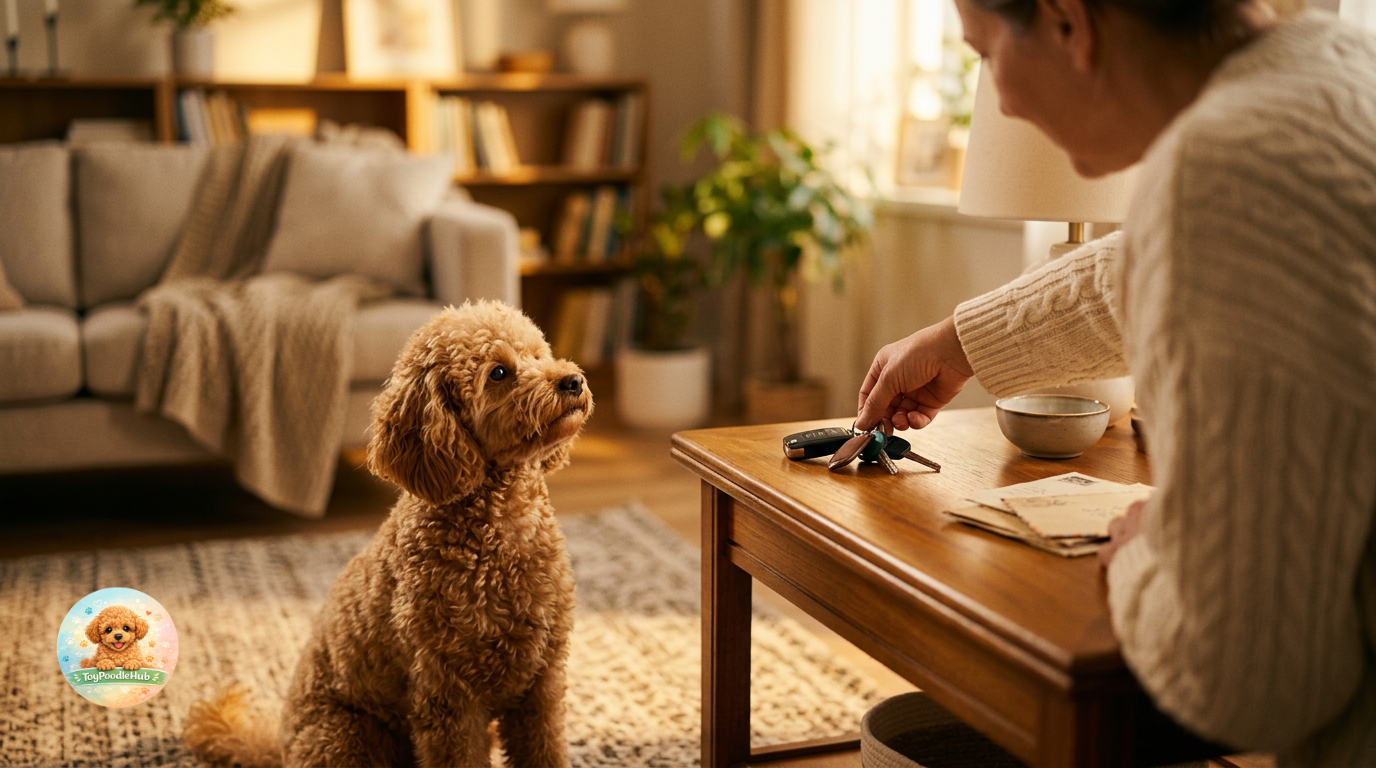
Why Your Toy Poodle Gets Upset the Moment You Pick Up Your Keys
If your Toy Poodle gets upset when you pick up your keys, it usually means your dog has learned that keys, shoes, bags, coats, or the front door predict you leaving. The anxiety often starts before you walk out because your Toy Poodle is reacting to the whole leaving routine, not just the time alone. The first step is not to keep leaving for longer and hope they “get used to it.” It is to make those pre-leave cues feel boring again, practice tiny calm separations, and return before your Toy Poodle tips into panic.
Why Keys Can Feel So Big To A Toy Poodle
Toy Poodles notice patterns very quickly.
That is one of the things I love most about them. My Toy Poodle can tell the difference between me walking to the kitchen, walking to the laundry, and walking toward the door with purpose. These little dogs read us all day.
So when the same routine keeps happening, they start joining the dots.
It may look like this:
- Keys
- Shoes
- Bag
- Coat
- Door
- Gone
After a while, your Toy Poodle does not wait for the final step. The worry starts at the first clue.
That is why Toy Poodle gets upset when you pick up your keys is not really a “keys problem.” The keys have become a warning sign. Your dog has learned that the sound, sight, or movement of them often means separation is coming.
The Moment I Realized My Toy Poodle Was Reading My Routine
At first, I thought my Toy Poodle was just being clingy.
He would lift his head when I touched my keys. Then he started following me to the door. Then he began pacing before I had even opened it.
That was the moment I realized he was not reacting to being alone yet. He was reacting to the possibility of being alone.
There is a difference.
A relaxed dog might notice your keys and then go back to sleep. A worried Toy Poodle may freeze, stare, whine, jump up, follow tightly, or try to block the door. Some will bark. Some will tremble. Some go completely quiet but look tense.
That early stress matters because your dog is already emotionally worked up before the absence even begins.
Why “Just Leave More Often” Can Backfire
A lot of owners are told to leave the house repeatedly until the dog adjusts.
That can help only if the dog is still calm enough to learn.
But if your Toy Poodle is already stressed at the sound of keys, then longer or repeated departures can accidentally teach the opposite lesson:
“Every time those keys appear, something scary happens.”
That is how the pattern gets stronger.
This is why I do not like pushing a Toy Poodle through panic. These dogs are smart, sensitive, and often very attached to their person. When they are scared, they are not being stubborn. They are overwhelmed.
A better goal is not to prove your Toy Poodle can survive you leaving.
The better goal is to teach:
- Keys do not always mean goodbye
- Shoes do not always mean panic
- The front door can open and close without drama
- My person leaves calmly and returns calmly
- Alone-time starts small and stays safe
That is the foundation.
Clingy Is Not Always The Same As Distressed

Toy Poodles are often called “velcro dogs” because they like being close. Some follow their owners from room to room simply because they are curious, bonded, and involved in family life.
That does not always mean there is a serious problem.
A clingy Toy Poodle may follow you around but still relax when you sit down. A distressed Toy Poodle struggles to settle, becomes tense around leaving cues, and may panic when the separation actually happens.
Watch for these signs:
- Pacing when you pick up keys
- Whining before you leave
- Jumping at your legs
- Following you tightly from room to room
- Staring at the door
- Barking as you prepare to go
- Ignoring treats
- Scratching at barriers
- Frantic greetings when you return
- Accidents that happen only during absences
If your Toy Poodle gets upset when you pick up your keys and also cries, barks, or paces after you leave, you may be looking at early separation distress rather than simple clinginess.
What Your Toy Poodle Is Actually Learning
Dogs learn by association.
If your keys always happen before you disappear, the keys become meaningful. If your shoes always happen before a stressful goodbye, the shoes become meaningful. If your coat always happens before a long absence, the coat becomes meaningful.
This is called a pre-departure cue.
Your Toy Poodle is not being dramatic. Your dog is predicting.
From your dog’s point of view, the sequence may feel painfully obvious:
“My person picked up the keys. Last time that happened, they left. I need to stay close.”
That is why the fix starts before the door.
You are not only training your dog to be alone. You are retraining the emotional meaning of the things that happen before alone-time.
The First Thing I Would Do Today
If your Toy Poodle gets upset when you pick up your keys, start by making the keys boring.
Not scary. Not exciting. Not a big training event.
Boring.
Pick up your keys, then sit on the sofa. Pick them up, then make tea. Pick them up, then put them back down. Pick them up, walk to another room, and return.
Do not leave every time.
The goal is to weaken the link between “keys” and “my person disappears.”
Keep it casual. If you turn it into a big performance, your Toy Poodle may still feel something important is happening.
Try this for one cue at a time:
- Pick up keys and stay home
- Put shoes on and sit down
- Lift your bag and walk to the kitchen
- Touch the door handle and return
- Open the door, close it, and stay inside
Do Not Practice Panic
This was the biggest shift for me.
I used to think progress meant longer absences. Now I think progress means calmer absences.
There is no point leaving for ten minutes if your Toy Poodle spends ten minutes crying, pacing, and panicking. That is not confidence-building. That is panic practice.
Start smaller than feels necessary.
For some Toy Poodles, the first step may be:
- Touching the keys
- Picking them up for one second
- Walking to the door without opening it
- Opening the door without leaving
- Stepping outside for two seconds
- Returning before the crying starts
That may feel tiny, but tiny is where confidence begins.
If one step causes stress, go back to the last easy step. That is not failure. That is good training.
A Simple 7-Day Key Cue Reset
This is not a miracle cure. It is a calm reset for Toy Poodles who are starting to react to departure cues.
Day 1: Watch The Pattern
Before changing anything, observe.
Ask yourself:
- Which cue starts the reaction?
- Is it keys, shoes, bag, coat, or the door?
- Does your Toy Poodle whine, pace, bark, freeze, or follow?
- How quickly do they settle again?
- Do they take treats?
- Does the reaction happen every time?
You need to know the first trigger.
For many Toy Poodles, the first trigger is not the front door. It is much earlier.
Day 2: Make Keys Boring
Pick up your keys several times during the day without leaving.
Keep your body relaxed. Do not stare at your dog. Do not ask for too much. Just make the cue normal.
Example:
- Pick up keys
- Walk to the kitchen
- Put them down
- Continue your day
If your Toy Poodle stays calm, quietly praise or reward.
If your Toy Poodle becomes anxious, make the next repetition easier.
Day 3: Add Shoes Without Leaving
Shoes are a huge cue for many dogs.
Put your shoes on, then stay home. Sit at your desk. Fold laundry. Watch TV. Make the cue meaningless again.
If your Toy Poodle gets upset when you pick up your keys, shoes may be part of the same emotional chain.
Do not rush this step.
Day 4: Practice Door Movements
Touch the door handle and return.
Then open the door slightly and close it.
Then open the door, step near it, and return.
Only step outside if your Toy Poodle is calm at the easier steps.
The front door should stop feeling like the dramatic final scene.
Day 5: Add A Settle Spot
Choose one predictable place where your Toy Poodle can relax.
This could be:
- A soft bed
- A pen
- A gated area
- A crate, only if your dog genuinely feels safe there
- A cosy corner near water and a safe chew
Practice this while you are home first.
Your Toy Poodle should not learn, “This bed means I am being abandoned.” They should learn, “This bed means I can relax.”
Day 6: Try Tiny Real Absences
Now try very short departures.
I mean tiny.
- 2 seconds
- 5 seconds
- 3 seconds
- 8 seconds
- 4 seconds
Come back before distress starts.
Do not make every repetition harder. Mix easy ones in so your dog does not start predicting that each round gets scarier.
Day 7: Repeat The Calmest Level
Do not push for a big win just because one day went well.
Repeat what worked.
Confidence grows from many successful easy repetitions, not one stressful challenge.
Should You Say Goodbye?
I do not make a dramatic goodbye with my Toy Poodle.
No emotional speech. No guilty voice. No repeated “be good, I’ll be back, I promise.” That energy can make leaving feel more important.
But I also do not sneak out in a way that makes my dog feel tricked.
I prefer one calm phrase, said once.
Something like:
“I’ll be back.”
Then I leave normally.
The phrase is not magic. It becomes useful only when paired with calm, manageable absences.
What If Treats Do Not Work?
If your Toy Poodle ignores food when you touch your keys, that tells you something important.
The step is too hard.
A dog who is calm can usually sniff, chew, lick, or eat. A dog who is worried may refuse even favorite treats.
Do not force the food. Do not wave it around. Do not assume your dog is being fussy.
Instead, make the exercise easier.
Try:
- Keys on the table, no movement
- Touch the keys, no picking up
- Pick up keys for one second
- Pick up keys while sitting down
- Pick up keys and immediately put them back
Then reward calm.
Food is useful, but only when your Toy Poodle is calm enough to receive it.
What If Your Toy Poodle Barks At The Door?
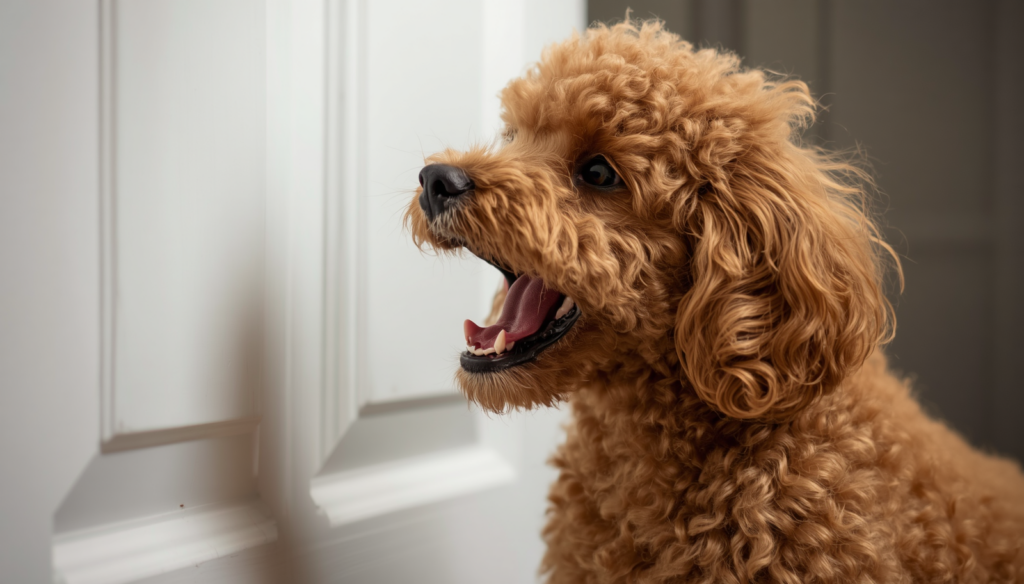
Barking at the door can be frustration, fear, alert behavior, or a mix of all three.
If barking starts as you prepare to leave, focus on the cue chain.
Do not wait until the barking is full-volume and then try to fix it. Go earlier.
Look for the first body-language change:
- Ears shift
- Head lifts
- Body stiffens
- Dog stands up
- Dog follows
- Dog stares
- Dog whines softly
That is your training moment.
Once the barking has exploded, your Toy Poodle is already over threshold.
What If Potty Accidents Happen Too?
Sometimes owners think the whole issue is anxiety when part of the problem is potty timing.
Toy Poodles are small dogs. Puppies especially have small bladders, and stress can make accidents more likely.
If accidents happen mainly when you leave, look at both sides:
- Is your dog anxious?
- Did they potty before you left?
- Was the absence too long?
- Is the routine predictable?
- Are they fully house trained yet?
For related support, read our posts on Why Toy Poodles Seem So Hard To Potty Train and Why Your Toy Poodle Is Peeing Inside Again.
What If Your Toy Poodle Gets Bitey Before You Leave?
Some puppies do not only cry or follow. They bite ankles, grab clothes, jump, bark, or act wild.
That does not always mean aggression. It can be overstimulation.
Your puppy may be tired, worried, or trying to keep you engaged.
A better pre-leave routine is calm, not chaotic.
Try:
- Potty break
- Short sniff walk
- Gentle training game
- Lick mat or safe chew
- Quiet settle time
- Tiny departure practice
The Mistakes I Would Avoid
When Toy Poodle gets upset when you pick up your keys becomes a daily pattern, it is easy to panic as the owner too.
I would avoid these mistakes:
Making The Goodbye Too Emotional
Your guilt can make the departure feel heavier.
Stay kind, but keep it simple.
Only Using The Crate When Leaving
If the crate only predicts absence, some Toy Poodles start fearing the crate too.
Build positive crate or pen time while you are home.
Moving Too Fast
A Toy Poodle who is calm for five seconds is not automatically ready for five minutes.
Small progress counts.
Punishing The Reaction
Punishment may stop one behavior in the moment, but it does not teach your dog to feel safe.
A scared Toy Poodle needs structure, not correction.
Waiting Until Workdays To Practice
Training should happen during low-pressure moments, not only when you actually have to leave.
When This Is More Than A Training Issue
Some Toy Poodles need professional support.
Please speak with a vet or qualified reward-based behavior professional if your dog:
- Hurts themselves trying to escape
- Destroys doors, crates, or gates
- Drools heavily when alone
- Pants or trembles intensely
- Screams for long periods
- Has sudden new anxiety as an adult
- Has sudden potty accidents
- Cannot settle even when you are home
Medical issues can make anxiety worse, and severe separation anxiety often needs a careful plan.
My Toy Poodle | Owner Takeaway
The biggest thing I learned is that my Toy Poodle was not reacting late. He was reacting early.
By the time I walked out the door, he had already watched the whole story unfold: keys, shoes, bag, door, goodbye.
So I stopped focusing only on the absence and started working on the build-up.
That changed everything.
If your Toy Poodle gets upset when you pick up your keys, do not treat the keys as a small detail. Treat them as the first page of the leaving story. Rewrite that page slowly. Make it boring. Make it safe. Make it predictable.
Your Toy Poodle does not need you to disappear for longer to “learn a lesson.” They need calm, repeatable proof that your leaving cues do not always lead to panic.
FAQ
Why does my Toy Poodle stare at me when I pick up my keys?
Your Toy Poodle is likely watching because the keys predict something important. If keys usually mean you leave, your dog may start monitoring you as soon as they appear.
Why does my Toy Poodle cry before I even leave?
Crying before you leave usually means your dog is reacting to pre-departure cues. The stress starts during the routine, not only during the absence.
Should I hide my keys from my Toy Poodle?
Hiding keys may avoid one trigger, but it does not teach confidence. It is better to gently make the key sound and movement less meaningful through calm repetitions.
Should I give my Toy Poodle a treat when I pick up my keys?
Yes, but only if your dog is calm enough to eat. If your Toy Poodle refuses food, make the exercise easier.
Is my Toy Poodle manipulating me when they get upset?
No. A worried Toy Poodle is usually reacting from stress, habit, or fear of separation. Treat the behavior as information, not manipulation.
How long does it take to stop key anxiety?
It depends on the dog, the severity of the anxiety, and how consistent the training is. Mild cue sensitivity can improve faster than true separation anxiety, but the safest approach is slow, calm repetition.
What should I read next?
Read Toy Poodle Puppy Training Tips for routine-building, Why Toy Poodles Seem So Hard To Potty Train if accidents are part of the issue.
Written by Toy Poodle Hub
Toy Poodle Hub creates practical, real-life resources for Toy Poodle owners dealing with puppy biting, potty training, barking, separation anxiety, and everyday routine challenges. This post is for educational purposes only and is not veterinary advice.