How Do I Create a Calm Bedtime Routine for a Toy Poodle?
A calm bedtime routine for a Toy Poodle can be as simple as this: lower the household energy, take one quiet potty break, return directly to the sleeping area and reward your dog for settling there. Follow the same order each night, even if the exact time changes. A familiar sequence is usually easier for a Toy Poodle to understand than a strict schedule.
Toy Poodles tend to pay close attention to people and patterns. If bedtime sometimes leads to cuddles, sometimes to fetch and sometimes to a trip to the kitchen, your dog has good reason to remain alert. A clear routine removes that guesswork. Their small size also calls for a few practical adjustments, including tiny rewards, non-slip flooring and a bed that does not require a leap from tall furniture.
Use a short, recognisable wind-down
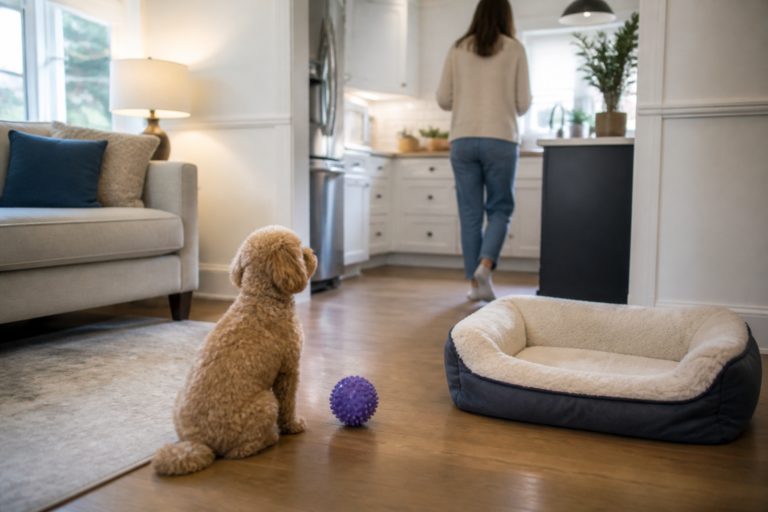
Begin shifting the mood before you expect your dog to sleep. Lively games and exciting training are better placed earlier in the evening. When the wind-down starts, toys can go away, voices can become quieter and movement around the room can slow naturally.
There is no need to create an elaborate nightly programme. A workable routine might take 15 to 30 minutes:
- Change the atmosphere. Turn down bright lights, reduce noisy household activity and finish any energetic play.
- Offer a quiet occupation if needed. A familiar chew, licking activity or small food search can bridge the gap between play and rest. Choose something appropriately sized for a Toy Poodle and supervise items that are new to your dog. If scent work helps your poodle unwind, the ideas in this guide to sniffing for Toy Poodles can also be adapted into a brief indoor search.
- Take the final potty break. Treat it as a practical outing rather than another walk. Keep conversation and play to a minimum.
- Go straight to the sleeping area. Detours past the food cupboard or toy basket can restart the evening.
- Say the bedtime cue once. A simple word such as “bed” is enough. Pause and let your dog process it instead of repeating it rapidly.
- Notice the first calm moment. When your dog lies down or relaxes into the bedding, place a very small reward low on the bed. Delivering it near the paws helps prevent an excited jump toward your hand.
After that, let the room become uneventful. Continued chatting, repeated treats or frequent eye contact may keep a socially attentive Toy Poodle waiting for the next interaction.
Set up the bed for a very small dog
The best sleeping place is one your dog can reach easily and use consistently. It may be a floor-level bed, an open crate, a pen or a familiar spot in your bedroom. Location matters more than style: a bed beside a busy doorway will be harder to settle in than one tucked away from regular foot traffic. A useful next read is Toy Poodle Crying When Left Alone: A Calm Owner’s Guide.
On wood or tile, place a non-slip mat beneath the bed and along the route leading to it. Toy Poodles are light and quick on their feet, but a slippery approach can make a small sleep station feel less inviting. Check that the bed is large enough for your dog to turn around and stretch without being so oversized that it loses its cosy feel.
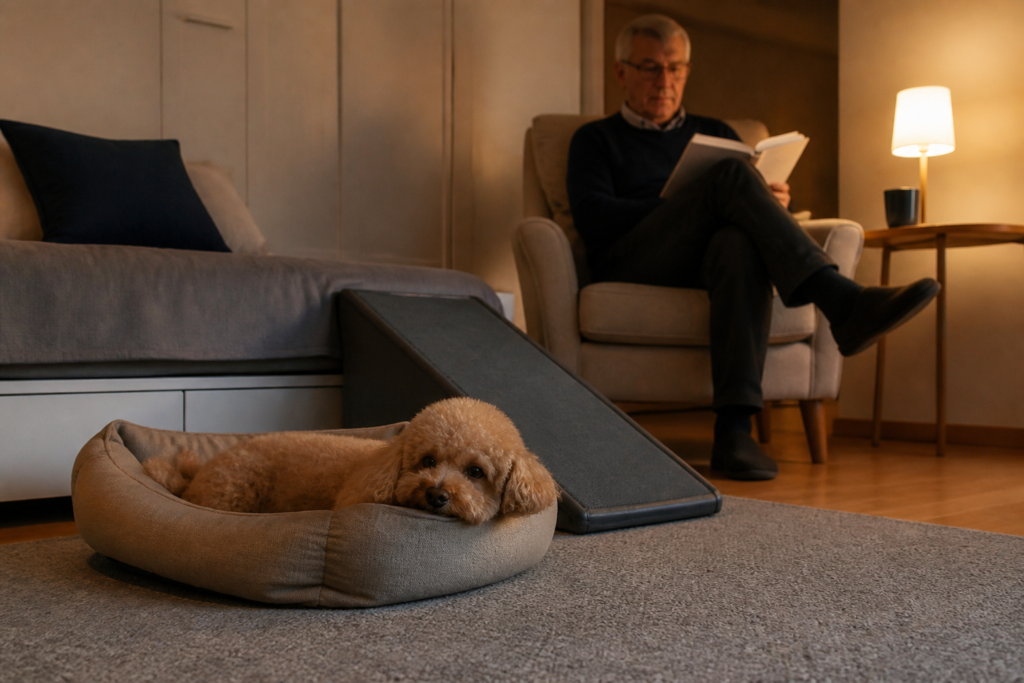
If your poodle sleeps on human furniture, plan how your dog will get up and down. A stable ramp or properly sized steps are preferable to making repeated jumps from a tall bed. Introduce the route during the day, when the room is bright and nobody is rushing. A comfortable floor bed remains the simplest option.
Also consider visibility. A tiny apricot, black or brown dog can be difficult to spot in dim light or dark bedding. Position the sleep area where household members will not accidentally step over it during the night.
Teach the bedtime cue outside the bedtime rush
A dog that has never practised going to a bed is unlikely to master it when everyone is tired. Short daytime sessions make the evening cue much clearer.
Place the bed nearby and quietly reward any voluntary interest in it. At first, that might be a glance, one paw on the edge or a brief step onto the bedding. Put the reward on the bed rather than feeding from an outstretched hand. Over several sessions, wait for all four paws, then a sit or lie-down. A useful next read is How Often Should I Brush a Toy Poodle Puppy? Daily Guide.
Once your Toy Poodle understands where to go, begin rewarding calmer details: a head lowered onto the bed, a hip rolled to one side or attention moving away from your hands. Keep each session brief. Several easy successes are more useful than a long exercise that turns the bed into a place of frustration.
A new crate See lightweight long-line options on Amazon (paid link), pen or sleeping room should be introduced in the same gradual way. Let your dog explore it during relaxed daytime periods before expecting it to become the overnight arrangement.
What to change when settling is difficult
| Bedtime behaviour | Likely routine problem | Practical adjustment |
|---|---|---|
| Your poodle races around or brings toys | The lively part of the evening is ending too close to bed | Move active play earlier and put favourite toys away before the wind-down begins |
| Your dog repeatedly gets off the bed | The room is still interesting or the bed is in a busy position | Reduce household movement and try a quieter corner with a clear view of you |
| The bedtime cue causes excited treat-watching | The reward has become the main event | Use a crumb-sized piece, deliver it low and leave longer gaps between rewards |
| Your dog avoids a new bed or crate | The change was introduced too quickly | Return to the familiar sleeping arrangement and build interest in the new one during the day |
| Attention-seeking continues after lights-down | Different household members respond in different ways | Agree on one routine and one set of rules about play, furniture and nighttime interaction |
Change one part of the routine at a time. If you simultaneously move the bed, alter the bedtime and introduce a new enclosure, it becomes difficult to tell which change matters.
Handling evening bursts of energy
A sudden dash around the room does not always require another vigorous game. Clear the floor, stay neutral and allow the burst to pass. Once your dog slows down, resume a familiar quiet activity rather than switching repeatedly between chase games and commands to settle.
The next evening, start the transition a little sooner. Toy Poodles can move rapidly from busy engagement to overtired commotion, particularly when an exciting household evening has kept them involved in every event. A longer buffer between play and sleep may solve the problem more effectively than trying to exhaust them at the last minute.
Make puppy bedtimes simple
A Toy Poodle puppy benefits from a sleeping area close to the household at first. Use a bed See suitable Toy Poodle crate options on Amazon (paid link), pen or crate that has already been introduced positively, and keep nighttime outings quiet and direct. Dim lighting and minimal conversation help distinguish them from daytime adventures.
If the eventual sleeping place will be farther away, shift it gradually rather than changing rooms in one night. Expect some turning, stretching and brief waking; the aim is not complete stillness, but an increasingly easy return to rest.
A quick bedtime check
- Energetic play finishes before the wind-down begins.
- The final potty outing stays brief and uneventful.
- The route to the bed has secure, non-slip footing.
- The sleeping place is warm, accessible and away from foot traffic.
- High furniture has suitable steps or a stable ramp.
- The bedtime cue is short and consistent.
- Rewards are tiny and placed low on the bed.
- Everyone in the home follows the same nighttime rules.
Look for gradual improvement rather than a flawless first night. A successful routine is one in which your Toy Poodle recognises what comes next, reaches the sleeping place without a burst of excitement and settles with less input from you over time.
More Living With a Toy Poodle guides
Browse more Living With a Toy Poodle guides or return to Start Here.