
Toy Poodle Adolescence: Why Training Suddenly Feels Harder
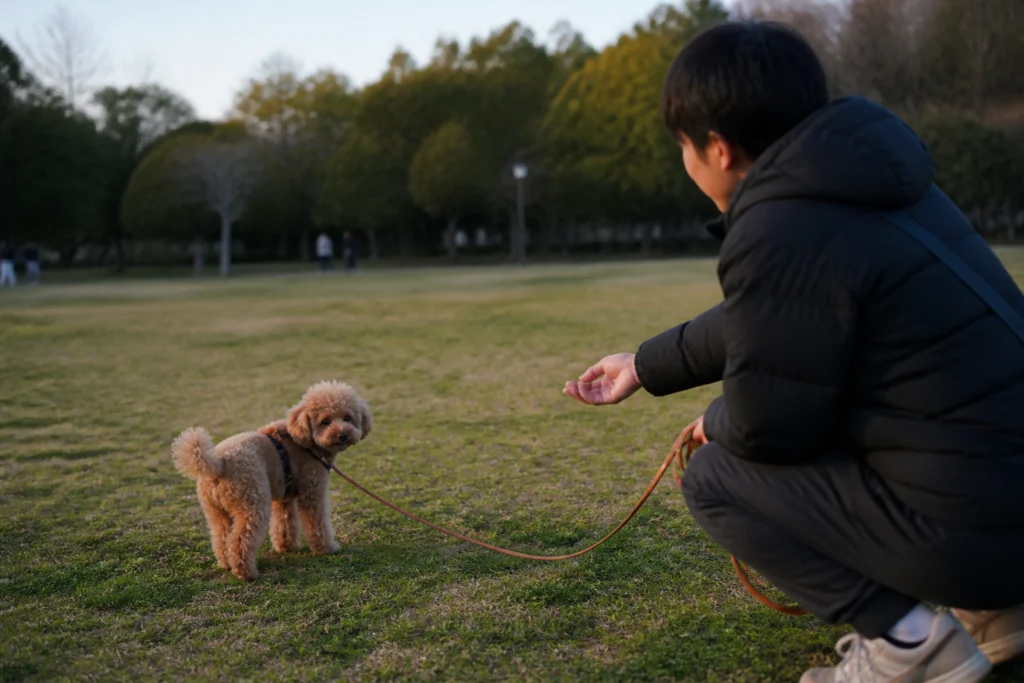
Toy Poodle adolescence often brings a noticeable shift in attention, independence and excitement. A dog who followed closely as a puppy may become absorbed in scents, hesitate before responding or find it harder to settle after an active day. Social choices, chewing habits and coat care can change as well. These fluctuations call for clearer routines and more thoughtful supervision, not harsher handling.
When does adolescence start?
There is no single date when a Toy Poodle becomes an adolescent. Changes often emerge during the latter half of the first year, then appear and disappear in waves beyond the first birthday. One week may feel remarkably easy; the next may expose gaps that were hidden in the puppy months.
Small size can also create a misleading impression of maturity. A Toy Poodle may have reached close to adult height while still struggling to leave an exciting smell, pause during play or relax in a busy room. Appearance and everyday self-control do not necessarily develop at the same pace.
Common changes at a glance
| What you may notice | What has changed | A useful adjustment |
|---|---|---|
| Responses are sharp indoors but patchy outside | The surroundings now compete more strongly for attention | Return to quieter practice areas and use better rewards |
| Your Poodle ranges farther on walks | Exploration has become more rewarding | Use a leash or long line while rebuilding connection |
| Play ends in barking, grabbing or frantic running | The activity continued beyond the dog’s ability to disengage | Build in pauses before play becomes chaotic |
| Greetings become hesitant or selective | Social preferences are becoming more defined | Allow calm passing without insisting on contact |
| Socks, tissues and other objects are stolen | Carrying an item reliably starts interaction | Prevent access and teach exchanges with ordinary toys |
| The coat takes longer to comb | Adult curls are replacing the softer puppy texture | Check friction areas more frequently and review the grooming schedule |
Individual Toy Poodles show different combinations of these changes. Context matters too: the same dog may be composed at home and almost unrecognisable near a lively path or group of dogs.
Skills become dependent on the setting
Adolescence often reveals that a cue was learned in a narrower context than it appeared. Sitting in the kitchen is straightforward. Sitting beside a moving bicycle, a barking dog or a patch of fascinating scent is a separate challenge.
Rather than testing the cue repeatedly, look at what is competing for your Poodle’s attention. More distance, a quieter position or a higher-value reward may be enough to restore success. If a response is unlikely, guide the dog with the leash and try again under easier conditions later.
Short sessions suit Toy Poodles well because the goal is precision, not endurance. Three successful turns toward you at the quiet edge of a park can be more valuable than ten minutes of asking for behaviors beside the busiest path. Tiny rewards are usually sufficient for a small dog, allowing several repetitions without turning the session into a meal.
Walks need a different balance of freedom and connection
A young puppy often stays close because the wider world feels unfamiliar. An adolescent may move with much more purpose, following scent trails or watching distant activity. That growing confidence is useful, but it can make unrestricted freedom premature.
When recall varies, a standard leash or long line preserves room to explore without relying on perfect decisions. In open spaces, keep a long line away from benches, trees, people and other dogs. It should be held securely rather than wrapped around a hand.
Connection can be encouraged without interrupting every sniff. Notice and reward moments when your Toy Poodle looks back, catches up after pausing or follows a change of direction. When appropriate, access to the interesting area can continue after the check-in. This makes staying aware of you part of the walk rather than the signal that all exploration is over.
For more ideas on structuring outings, see how much sniffing a Toy Poodle needs on a walk.
Excitement can spill over quickly
Adolescent Toy Poodles can move from engaged to overexcited in a short period. Lead grabbing, repeated jumping, sharp barking or racing around with a toy may appear near the end of play, during arrivals or when an outing has lasted too long. For the next part of this routine, read Why Does My Toy Poodle Follow Me From Room to Room?.
The most useful moment to respond is before the behavior gathers momentum. A brief pause, a scatter of food to find, a drink break or a change to a quieter activity can bring the intensity down. If every game ends in chaos, shorten the game rather than demanding more control at its most difficult point.
More activity is not always the answer. A day packed with chasing, energetic play and busy environments may leave a Toy Poodle less able to switch off. Sniffing, simple search games, calm trick practice and uninterrupted rest provide contrast. In the evening, a familiar sequence can signal that stimulation is finished; this guide to a calm bedtime routine offers a practical framework.
Social confidence may look different
A puppy who once approached everyone may become choosier during adolescence. That does not mean every walk should become a round of compulsory greetings. Passing another dog with a loose lead, watching from a comfortable distance or moving behind the owner are all useful social behaviors.
Toy Poodle size deserves particular consideration. Even friendly play can be overwhelming when the other dog is much heavier or repeatedly knocks the Poodle over. Compatible play partners should be able to pause, change roles and respond when the smaller dog moves away. Ending a session while both dogs remain responsive is easier than separating them after the pace has become frantic.
Picking up a Toy Poodle can be sensible when there is an immediate size or traffic hazard. In ordinary situations, however, moving away together often teaches more. A cheerful turn, a few quick rewards for following and extra distance give the dog a repeatable way to leave an unwanted interaction.
Household mischief may reappear
Chewing and object stealing often return because they produce reliable entertainment. A sock prompts a chase; a tissue can be shredded; a shoe carries interesting household scents. For a quick, observant Toy Poodle, those outcomes can establish a strong routine.
Good storage does much of the work. Laundry behind a closed door, cables out of reach and small objects removed from low surfaces prevent repeated practice. Several appropriate chew and play options can then be rotated so they remain interesting.
If your Poodle collects something harmless, avoid turning the room into a racetrack. An exchange for a reward or another toy keeps the interaction calm. The exchange game is easiest to establish with low-value toys, long before it is needed for a prized stolen item.
The adolescent coat changes the grooming workload
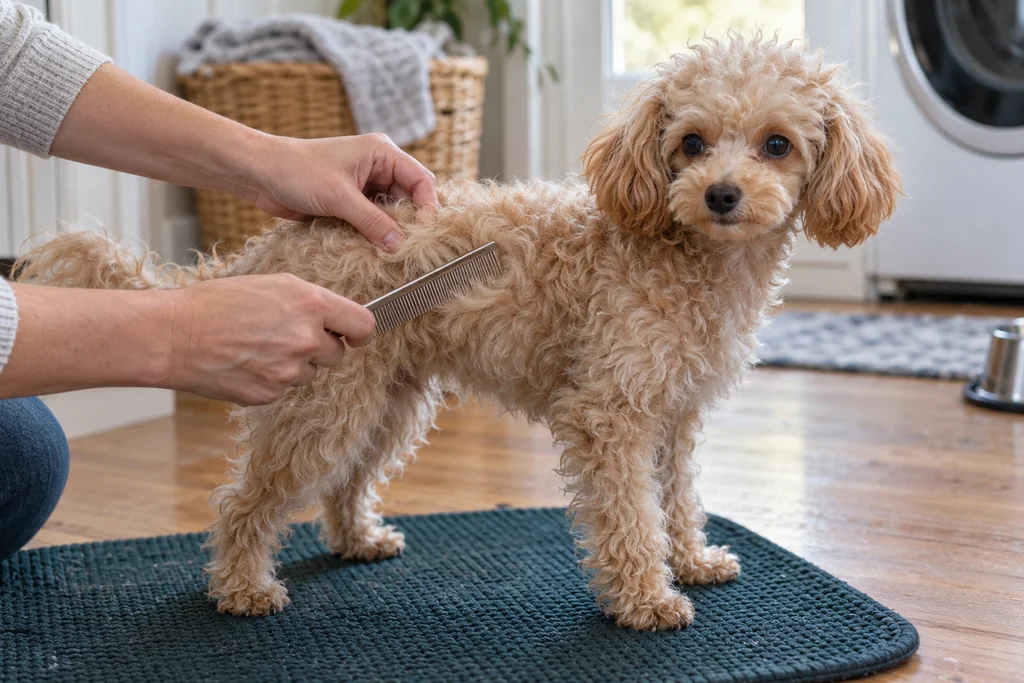
The shift from puppy fluff to adult curls can make grooming feel unexpectedly demanding. The coat may separate neatly on top while compacted sections remain around the base of the ears, under a harness, along the legs or anywhere clothing creates friction.
A practical routine uses brushing to divide the coat into small sections, followed by a comb to confirm that each section is clear from tip to root. Rushing over the visible surface is less effective than working methodically through one area at a time.
Adolescence can also bring less patience with handling. Instead of saving the entire coat for one long session, divide the job across the week. One session might cover the legs and chest; another might focus on ears, tail and harness areas. Calm standing, turning on cue and offering a paw can become part of the grooming routine rather than something separate from training.
Hair length influences workload. If home care has become a constant struggle, a shorter, practical trim may suit daily life better than maintaining a longer style through the coat transition.
A simple reset for an inconsistent week
When several adolescent habits appear at once, changing everything immediately can make progress hard to judge. Start by choosing the two situations causing the most disruption.
First, reduce opportunities for mistakes
- Bring back gates, closed doors or closer supervision in problem areas.
- Use a leash where wandering or unreliable recall has appeared.
- Put tempting household objects away before the dog finds them.
- Finish play sooner and allow a quiet interval afterward.
Next, rebuild one useful response
Select a skill that directly helps with the problem: turning toward you on walks, releasing a toy, settling on a mat or standing for a short grooming check. Practise it in an easy location for a minute or two, then finish. Several small successes across the day are easier to absorb than one long lesson.
Finally, change only one variable
Once the response is steady, add either more time, more distance or a mild distraction. Keeping the other parts simple makes it clear what your Toy Poodle can currently manage. If attention disappears, step back to the previous version instead of saying the cue again and again.
Habits that make adolescence harder
- Giving the same freedom the dog had during an easier puppy phase
- Using repeated cues as background noise
- Forcing greetings to make the dog appear sociable
- Allowing exciting games to continue until the dog can no longer disengage
- Chasing stolen objects and accidentally creating a favourite game
- Expecting a small dog to cope safely with rough play from much larger dogs
- Postponing coat checks because the outer curls still look tidy
Look for trends, not perfect days
Toy Poodle adolescence rarely progresses in a straight line. A failed recall or restless evening does not erase previous learning, just as one excellent walk does not mean supervision is no longer needed. Review what happens across several settings and days.
A short note can reveal useful patterns: where attention dropped, how long the activity lasted and what helped your dog reconnect. Over time, those details show when more freedom is appropriate and where practice still needs to be simplified.
The aim is not to suppress curiosity or independence. It is to give an adolescent Toy Poodle enough structure to make safe choices while preserving exploration, play and learning. With consistent routines and well-timed adjustments, the unsettled phases gradually become the foundation for reliable adult habits.